


Josh Whitehead / The SWC Sun
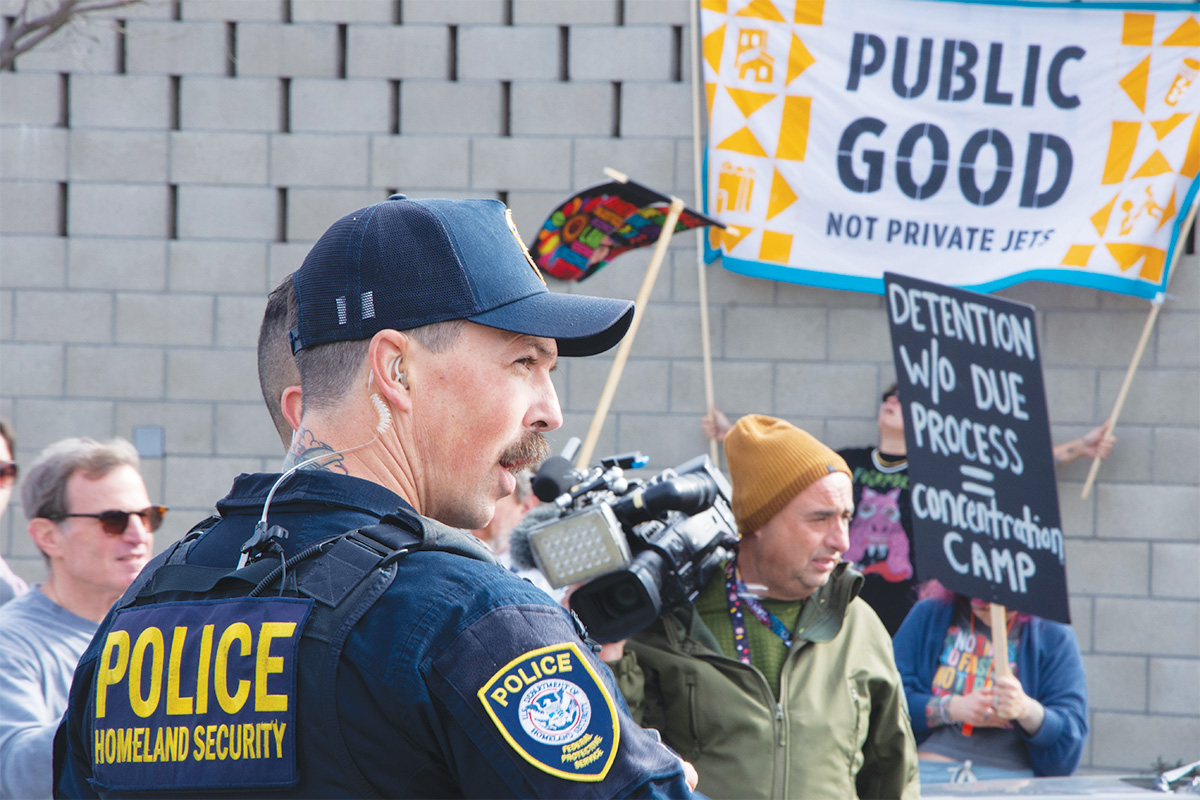
THE ICE MAN COMETH—ICE personnel moved protestors away from the Otay Detention Center as Homeland Security Director Kristi Noem approached.
By Arianna Antillon
ICE has not yet set foot on any of the four Southwestern College academic campuses, but its aggressive activities at other South Bay schools has the community on edge, according to students and staff. Its Otay Mesa Detention Center is one of the largest and most populated in the nation. It is visible from three SWC campuses and a short drive to each.
Immigration and Customs Enforcement personnel dressed in military combat gear have arrested parents in the streets bordering two Chula Vista elementary schools. In both cases
children were left behind. ICE also set up a roadblock alongside Bonita Vista Middle School on Otay Lakes Road—less than a mile from Southwestern—but made no arrests.
Messages from campus officials indicate that they have met with ICE and border patrol representatives and asked them to stay off Southwestern College campuses in Chula Vista, San Ysidro, Otay Mesa and National City. Campus Police Chief Marco Bareno said the college is trying to be proactive.
“Our department maintains established lines of communication with regional and federal law enforcement agencies, including ICE, to ensure they understand our mission to protect our college community,” Bareno said.
Southwestern College President Dr. Mark Sanchez indicated that campus officials expect ICE to follow federal law. Agents on campus to make an arrest are required to have proper warrants and to contact campus police or the president’s office, he said.
Sanchez and Bareno have written several email messages to faculty and staff over the course of a year. They encourage faculty to remain calm and professional, but not to actively cooperate or identify students.
College leaders, however, made no formal effort to communicate with students. A group of students visited an Academic Senate meeting to share their unhappiness about being left out of the loop. Faculty senators encouraged them to share their concerns directly with the governing board. Alexis Ramos and others did just that.
“On the Southwestern College website there is no information about ICE or what to do if they come on campus,” Ramos told the board. “We’ve been walking into different classrooms writing down the College Police (phone) number and what to do in case ICE does come on to campus.”
Kippy Martinez, a first-generation student, said she was anxious about ICE.
“I have feared (ICE entering campus) since I only have my Mexican documents and citizenship,” she said. “It’s scary, but I feel like I might be fine based on the fact that I look pretty white.”
Martinez said she knows darker-skinned people who would like to attend Southwestern College that are afraid to be on campus.
“One of my friends who is a Southwestern student started taking online classes so she doesn’t leave the house because of ICE,” she said. “She does not feel safe on campus.”
Martinez said one of her professors told her class what to do in case ICE enters campus. Southwestern College distributed a flyer to faculty last fall that listed ICE protocols.
A recent visit by now-former Department of Homeland Security Director Kristi Noem did not allay fears. Wearing a $50,000 Rolex watch, Noem posed in front of a stack of brown cardboard boxes she said were full of fentanyl captured from “criminals crossing the border.” She said, without evidence, that Mexican and Central American immigrants were often drug smugglers who were “poisoning America.”
“Fentanyl is killing Californians every day and we are meeting this crisis with action, not rhetoric,” she said.
Noem refused to answer a question from a student reporter who asked if any of the detainees in the Otay Mesa facility were specifically charged with smuggling fentanyl.
Protesters on the other side of a fence hollered for Noem’s resignation. They held signs critical of the Trump Administration’s immigration policies. It is unlikely Noem heard them because as she passed near them ICE personnel blasted horns and sirens to drown out their voices. Protesters persisted and did not leave when agents with heavy weaponry formed a line in front of them. Noem said, without evidence, that immigrants inside the Otay Mesa Detention Center were properly cared for.
Local news media, protesters and international human rights organizations disagreed. Otay Mesa is operated by a private contractor hired by the federal government that has indicated it does not have to meet government standards for the treatment of detainees. CoreCivic, a private prison company, has been severely criticized by human rights activists and elected officials, including U.S. Senator Alex Padilla, who has been refused entry to the facility several times.
Noem said all is well in the prison.
“We are proud of the fact that every single individual, when they come, is well taken care of,” she said.
There are nearly 1,400 detainees at the Otay Mesa facility, making it one of the five or six most populous in the United States. The detention center is minutes away from Southwestern’s Otay Mesa, San Ysidro and Chula Vista campuses.
A MESSAGE IN A BOTTLE
Protesters hold weekly visits and attempt to communicate with detainees from outside the center. Wailing and screaming of men and women locked inside echoes through the cold walls of the colorless grey center. Mara Lucia is one of the activists who have visited the center every week for seven months.
“When we started speaking through the megaphone, we hear people screaming ‘thank you for praying for us!’’’ she said. “We made sure at least to let them know what day it is. Inside the facility they don’t have a notion of time or what day it is.”
Lucia shouted in different languages through her megaphone, offering comfort and encouragement for the detainees huddled inside.
“I know there are Americans, Canadians, French, Brazilians, Chinese and Africans inside so it is important that we get messages to those people,” she said.
Activists received an unusual and desperate message from a detainee who managed to throw a lotion bottle over the pair of fences on the center. Arturo Gonzalez read the note aloud.
“It’s cold in here, the food is very poor,” he read. “For 250 days we haven’t had a single piece of fruit. We’re in a big room with no windows or doors. We can’t see any grass or trees. We’re constantly sick. We are pleading for help.”
Gonzalez said detainees are often held without charges and none received a proper trial. Activist Blue Wong agreed.
“Families are not permitted to visit their loved one inside the facility,” she said. “They are not visiting in person anymore because every time they get a visitor the hostage gets a full-blown invasive strip search. It is humiliating.”
Wong said that on weekends activists play music for the people inside to “bring some light to their dark days.”
“These people are not criminals,” she said. “They haven’t broken any law. Their paperwork was even stellar.”
‘WE HAD AN AGREEMENT!’
Protesters stood near the prison’s perimeter in between woodchips and flowers. Protesters shouted words of encouragement in an array of languages, a United Nations of hollering hopefulness. A patrolling guard pulled his vehicle up to the linguistic legerdemain.
“We had an agreement!” shouted an angry guard.
Wong calmly stepped in front of the guard.
“We will move,” she said.
Her fellow protestors followed her lead and moved off the road.
“The agreement is that if we keep our people on this side and not block the road, then they will allow (detainees) out at rec(reation) time when we’re here on Sundays between 1:15 and 3:15 p.m. so that we can communicate back and forth,” Wong said.
Soon after the killings of two protesters in Minneapolis, ICE has lowered its profile in some American cities. That has not been the case in the region that comprises the Southwestern Community College District.
“It’s kind of scary to think about the fact that ICE is headquartered in this community,” said SWC student Renaldo Hernandez. “They are like sleepy snakes who lay low for a while then strike without notice.”


