


Yanelli Zavina Robles / The SWC Sun
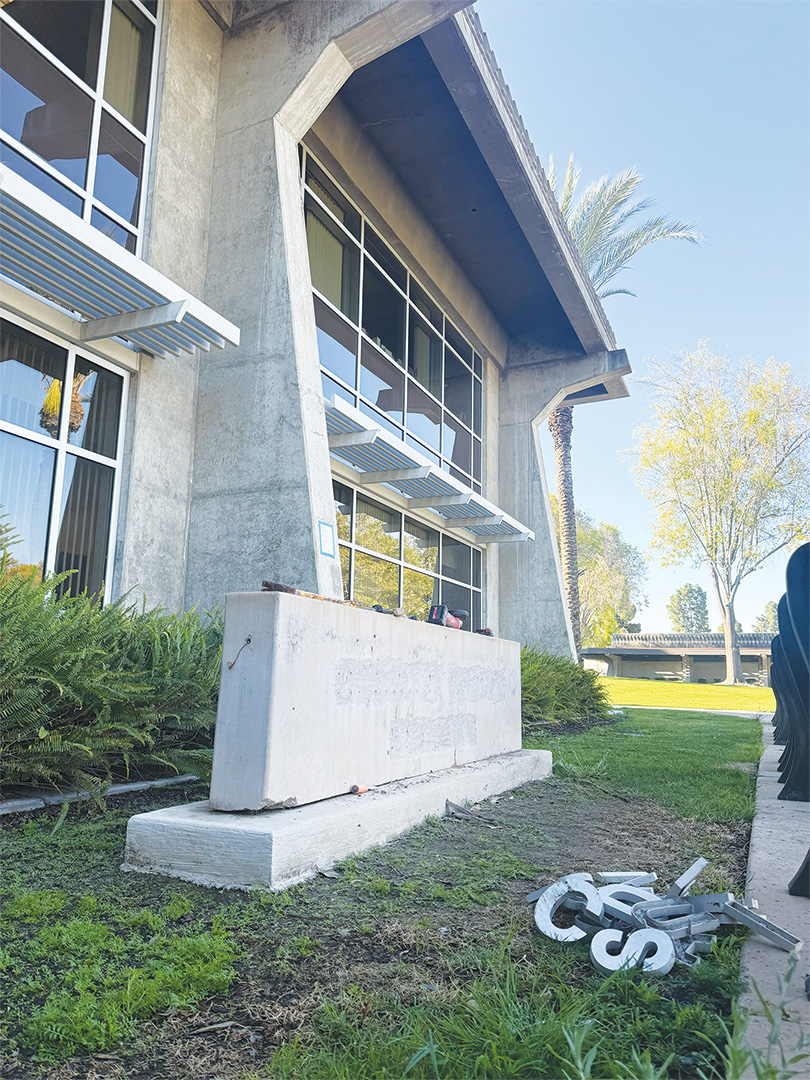
THE MIGHTY HAS FALLEN—Campus work crews began removing the name Cesar Chavez from buildings and signs the same day news of sexual abuse by the UFW icon broke in the New York Times. SWC President Dr. Mark Sanchez said he would form an ad hoc committee to consider a new name for the student services building.
By Arianna Antillon
As a Latino legend fell from grace, all signs of the once-venerated Cesar Chavez literally fell to the ground at Southwestern College.
Just hours after a devastating New York Times investigation reported shocking sexual misconduct allegations against the revered farm workers rights leader, college crews scrambled to remove Chavez’s name from the Student Services Building, the center-of-campus edifice that houses admissions, counseling, financial aid and other essential student-related departments. By morning, the letters that once spelled out pride and achievement for American Latinos were piled unceremoniously on the ground like a pile of dusty basura, pried with crowbars from their place of honor gracing the entrance.
RELATED STORY: Student Center Getting Renamed
RELATED STORY: Time to End Sexual Assault Silence / Opinion
RELATED STORY: Betrayed Everyone Who Looked Up To Him / Opinion
RELATED STORY: Latino Community Responds / Editorial
Chavez’s name was also hastily deleted from an annual scholarship breakfast and taped over on campus maps. Within 24 hours all evidence of the man held up for generations as an American icon had essentially vanished.
College President Dr. Mark Sanchez, a one-time admirer of Chavez, was quick to condemn him as allegations of rape by union co-founder Dolores Huerta and sexual abuse of minors came to light following an exhaustive five-year Times investigation. Huerta is a Southwestern College Honorary Degree recipient and the subject of a mural by legendary Chicano artist Salvador Barajas owned by the SWC Foundation.
“What we are learning from Dolores Huerta…is heartbreaking for communities who looked up to someone who was seen as a champion of workers’ rights and those exploited by the powerful few,” he said in a statement. “The hypocrisy rests with the individual, and not the movement. My care is first centered on Dolores Huerta and other women affected by sexual violence.”
Sanchez said he will convene a group of campus leaders to consider a new name for the Student Services Building. Many campus leaders and students have already indicated they support renaming the building for Huerta.
The New York Times article was published less than two weeks before Chavez’s March 31 birthday. The Southwestern College Chicano-Latino Coalition abruptly cancelled its 19th Annual Cesar E. Chavez Scholarship Breakfast and United Farm Workers Flag Raising. Director of Student Equity Dr. Guadalupe Corona said she expects there will be a future event to recognize the scholarship winners and honorees Roger and Norma Cazares. Corona accidentally damaged the wall above her desk removing three paintings of Chavez given to her by former students.
“I hope this serves the community as a good lesson to believe our children and women that these things do not belong under the rug,” she said. “This is a dispiriting morning, but also an opportunity to reevaluate our long history of sexual abuse by the powerful.”
Yanelli Robles, the Editor-in-Chief of The Sun, was
interviewed for the KUSI News about the accusations of sexual misconduct by Chavez and
revealed that she was also a victim of sexual abuse as a little girl.
“As a victim myself of sexual assault, it was very triggering, but also very healing to see that women have the strength and the courage to speak up even after so many years have gone by,” she said. “This type of action opens the door for victims of sexual abuse to feel seen, heard and even comfortable coming forward with their experiences.”
She said she was glad to see the Chicano community so roundly denounced Chavez for his behavior toward women and girls.
“I think this is a moment for us to realize that (sexual abuse) has never been okay and it’s never going to be okay,” she said. “We need to hold the abusers accountable and there needs to be repercussions for these actions.”
Robles said the Student Services Center should be renamed for Huerta.
“She was the co-founder of the union and probably the real brains behind its success,” she said. “Cesar Chavez got most of the credit, but without Dolores Huerta the UFW Movement would not have been successful. She is the one who coined the phrase “Si se puede!’”
DOLORES HUERTA REVISITED
Southwestern College is practically a second home for Huerta, who speaks on campus regularly. She is known and loved by scores of campus employees, said Corona. In 1999 Huerta was awarded the college’s highest recognition, an Honorary Degree. She drew a packed house to the SWC Performing Arts Center for a speech in 2022.
Dolores Clara Fernandez Huerta, 95, remains the activist she was in the 1960s and 1970s during the halcyon days of the UFW Movement. She and Chavez founded the Union Farm Workers in 1965. She led the1965 Delano Strike of 5,000 grape workers, which led to the California Agricultural Labor Relations Act of 1975. It mandated safer working conditions, the elimination of harmful pesticides, healthcare benefits and basic rights for agricultural workers.
In 1972 Huerta hit a roadblock with the Arizona Legislature, which banned farmworker strikes. She called for a boycott of Arizona corporate agriculture conglomerates. She often tells the story of people who tried to discourage her.
“‘Oh, Dolores in California, you can do all those things, but here in Arizona, you can’t. In Arizona, no se puede.’ My response was ‘Sí se puede in Arizona!’” she said.
Chavez would later use that same phrase to inspire people, most of whom did not seem to know it originated with Huerta.
For the past 60 years Huerta has advocated for farmworkers across the nation. Yet as she was fighting for others, she kept a terrible personal secret. In the New York Times article and a follow up piece the next day she described being raped twice by Chavez and bearing two children.
“I believed that exposing the truth would hurt the farmworker movement I have spent my entire life fighting for,” she wrote following the Times investigation. “The formation of a union was the only vehicle to accomplish and secure those rights, and I wasn’t going to let Cesar or anyone else get in the way.”
Corona said there was great nobility in Huerta’s decision.
“Dolores took one for the team,” Corona said. “She suffered for years because she knew if she had come out earlier it could have destroyed the movement that so many of us would benefit from.”
Huerta learned recently that Chavez had also victimized children.
“I am telling my story because the New York Times has indicated that I was not the only one– there were others,” she told the Times.
Ana Murguia and Debra Rojas, daughters of long-time union organizers, told the Times they were molested by Chavez as 13- and 12-year-olds. Rojas said Chavez raped her when she was 15. Huerta said learning about the abuse of children encouraged her to share her experiences.
“I have kept this secret long enough,” she said. “My silence ends here. Sí se pudo.”


