


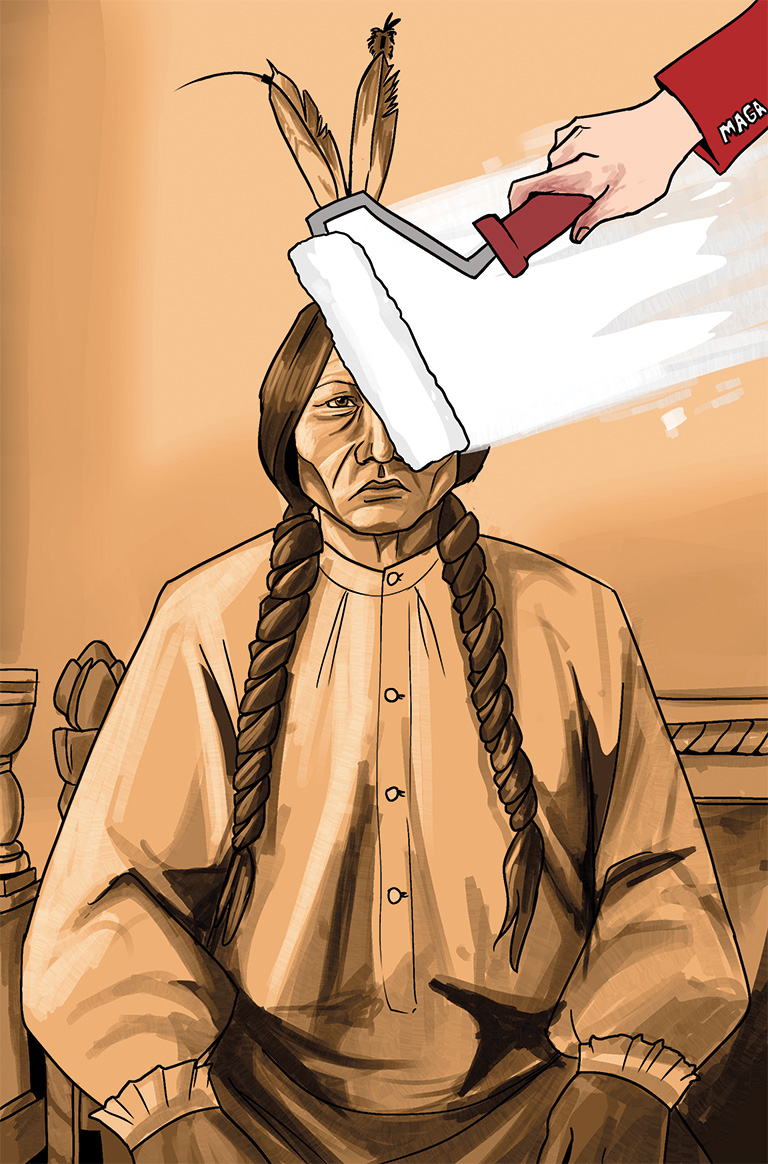
Carla Labto / The SWC Sun
By Deqa Hussein
A Perspective
Native Americans are the most mistreated people in the history of the United States. That is a pretty bold statement for a nation that enslaved Black People, treated Latinos and Asians like expendable cheap labor, and routinely treats Muslims like unwanted terrorists. Only Native Americans, though, were targeted for extermination.
Americans and Mexicans of the late 1880s almost completed the job. The United States has less than 2 percent as many Indigenous People as the region did at the arrival of Columbus. Indigenous women are still disappearing and are, next to transgender people, the most murdered of all Americans.
It has just been the last 30 years or so that Native Americans have started to get a better shake in American history books, film and television. Still tiny, but at least some consideration.
And then it all came to an end. The Trump Administration’s efforts to return America to the robber baron Gilded Age of the 1880s and 1890s, as well as the genocidal Indian Wars of the same period conjure the motto of the time – “the only good Indian is a dead Indian.”
Trump’s pogrom to depopulate America of people of color has nearly erased discussions of systemic racism, slavery, segregation and Native American history. Republicans and MAGA voters consider these “divisive” and “prejudicial to White Americans.”
Teachers are feeling pressure to back away from these topics, even in supposedly progressive California. Jennate McCury, a teacher at Wilson Middle School, said she is one.
“In the past I could give students a more holistic view of history, discussing the forced removal of Native People, the Trail of Tears and the struggles faced by Native Americans in the development of the United States,” she said. “But now I have to be more careful about how I frame these lessons.”
Real Native American history is being omitted or watered down in new curriculum guidelines in some large red states like Texas, she said, which is encouraging textbook publishers nationwide to follow suit. More progressive blue-leaning states often end up with the same whitewashed curriculum as publishers try to keep customers satisfied.
“The truth about the Trail of Tears and the impact of the westward expansion on Native American communities is no longer discussed in detail,” she said. “It’s as if we’re only telling part of the story. Some teachers feel trapped, not able to fully teach the subjects they’re passionate about. But we feel we have to comply to keep our jobs.”
McCury said she worries about the long-term impacts on students.
“If we don’t teach the full story, how will they ever understand the history of this land and the impact Native American communities have felt?” she said. “It is important for students to learn about these struggles so they can recognize the same patterns in society.”
Yasmin Hasan, a Wilson Middle School student, agreed.
“We don’t talk about the Trail of Tears or the forced relocation of Native Americans (like we used to),” she said. “It’s like the lessons are rushed or simplified without giving us the full picture.”
Hasan said she feels like she is receiving an inferior education.
“I’ve learned about Pocahontas and a few Native American leaders,” she said, “but not much about the real struggles Native Americans faced and the cultural erasure they have experienced. It’s like we only hear about a few select stories and not the deeper history.”
Dumbing down history gives students an unrealistic view of American society and damages their ability to think critically, said Hasan.
“We are not being taught to think for ourselves,” she said. “We are just memorizing the ‘safe’ version of history.”
McCury said shallow curriculum fuels ignorance.
“If we don’t talk about these issues, students won’t understand the challenges Native Americans still face,” she said. “They won’t know to recognize injustice.”
Conservative organizations like the Heritage Foundation argue that teaching about past injustices hurts society by causing divisions and making the White majority population “uncomfortable.” A Heritage Foundation article titled “Why Banning Critical Race Theory is Necessary” argues that removing discussions of systemic racism from K-12 classrooms will prevent teaching politically-charged content.
“By emphasizing shared values and historical achievements, schools can avoid creating divisions based on race and instead foster a more inclusive and harmonious society,” reads the article.
Educators should not highlight America’s flaws or past mistakes, the article said. Most educators reject that notion and advocate for a comprehensive approach to history that is accurate, truthful and fair. Sanitizing history is propaganda and allows the continuation of toxic mythology and poor policy making.
Gloria Steinem’s dictum “The truth shall set you free” resonates today. For America to evolve into a nation of “liberty and justice for all,” its people need to know its history…even if it’s uncomfortable.


