


Courtesy of the Bartow Family
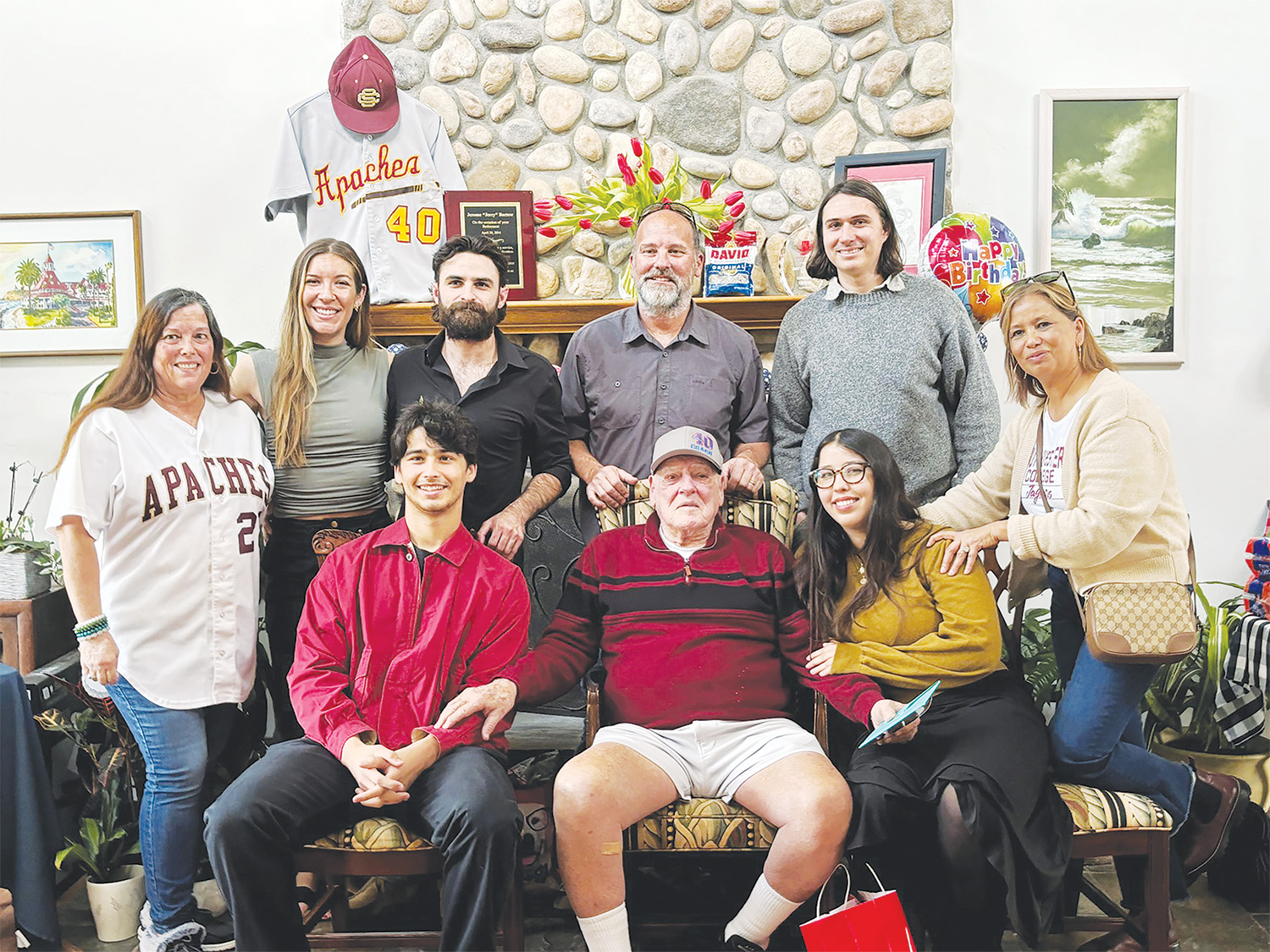
LOVABLE LEFTY—Jerry Bartow (front, c) at home with his family. SWC’s most successful coach was also one of the college’s best-known professors. Besides winning 907 games in 39 years as the baseball coach, he advised the cheerleading team, sent 20 players to Major League Baseball, raised hundreds of thousands to build one of the region’s best diamonds and was a 2012 Honorary Degree recipient.
By Alfonso Julián Camacho
Jerry Bartow had reached his limit with an umpire not having a good day.
After the ump called a Southwestern College baserunner out at the plate on a bang-bang play, the 78-year-old coach threw his hat to the ground with his left hand and pointed at the beleaguered man in blue with his right.
“I’ll show you!” Bartow shouted, red faced.
Whereupon he sped to the spot in the infield the third baseman would typically stand and started to replicate the play. His left foot hit the inside of the bag in perfect form, then he barreled the final 90 feet like a locomotive on a mission. He crossed the plate with a flawless hook slide, dragging his trailing right foot over the far side of the plate, in his mind evading the catcher’s lunging tag attempt.
“That’s how it happened,” Bartow said as he dusted off his backside and the burgundy 40 on front of his soiled jersey.
“He’s still out, Jerry!” hollered the umpire.
Bartow had a zinger ready, but his teenage player was standing close by so he kept it to himself. He patted his player on the back.
“Sorry, babe,” he said. “Ump’s too stubborn to admit he’s wrong.”
The scowling ump stepped toward Bartow and the dusty young Jaguar and raised his right hand with his thumb extended. An ejection seemed imminent for Bartow, but then the umpire chuckled and pulled on his mask.
“Jesus, Jerry!” he said. “You’re crazy.”
Bartow started to laugh.
“First right call you’ve made all day!”
Jerome “Jerry” Bartow was crazy like a fox, insist his friends and former players. He was eccentric, a brilliant strategist, a champion, a hall of famer, a groundskeeper, a teacher, salesman, fearless driver of a dilapidated baseball bus and entertainer. He was a gopher assassin, savior of cheerleaders and Chula Vista’s Father Christmas.
He was also loved. Deeply.
Bartow died on September 11 just as the baseball season was in its final stretch. He was 91.
COLLEGE COACHING LEGEND
He coached the SWC baseball team for 39 years starting in 1976 after wrapping up 16 years at Hoover High School. He won three CIF titles at Hoover and 11 conference titles at Southwestern. His 2009 team played for the California Community College Championship. He retired at age 79 with 907 victories at SWC.
Bartow liked to say he began his life with a splash. His mother was a Wiyot Indian who gave birth to her child in a river near Otis, Oregon. He was given up for adoption and taken in by Major League Baseball legend Carl Mays of the New York Yankees – best known for accidentally throwing the pitch that killed Cleveland Indians shortstop Ray Chapman in 1920. It remains MLB’s only on-field fatality. Mays was also the roommate of baseball deity Babe Ruth. He nearly brawled with the legendary Ty Cobb when Cobb threw his bat at him after a few pitches up and in. Cobb called Mays a “no good son of a bitch.” Mays stood his ground and called Cobb a “yellow dog.”
Mays had a reputation for being a cantankerous player, but Bartow said he was a good dad who spent lots of time teaching him how to pitch, shoot baskets, throw footballs and box. Bartow lettered in baseball, football, basketball and boxing at Taft High School and was a stellar badminton player. Mays was a font of wisdom and offered sound advice throughout his life, Bartow said, and guided him through a series of good decisions.
In high school Bartow was the talented quarterback of the football team that played for the state championship, and all-league in baseball and basketball. He said he had hoped to play quarterback at Oregon State but accepted a scholarship to Washington State University to play baseball. Bartow pitched the Cougars to the Pacific Coast Athletic Conference title and a spot in the 1956 College World Series by beating USC. In 1958 he pitched for the Drain, Oregon Black Sox, winning the National Baseball Congress championship, an annual tournament for elite college and semi-pro players held in Wichita, Kansas. Satchel Paige, Don Sutton, Tom Seaver, Ozzie Smith, Tony Gwynn, Barry Bonds, Roger Clemens and Albert Pujols all played in the tournament.
Dreaming of a Major League career like his step-father Carl Mays, Bartow pitched professionally for two years with the Salem (Ore.) Senators. Mays gave him some life-changing advice. He pointed out that the minor league salaries of the time topped out at about $1,500 a season and encouraged Bartow to return to school for a Master’s degree. The old righty convinced the young lefty to go back to Washington State and grad school.
Bartow earned a Master’s and departed for San Diego and a teaching job at Hoover High School in 1961. He started coaching baseball in 1962, completely transforming the program – including the ratty baseball field. Word of his ambitious rehabilitation plans got around. He received a call and a sizable donation from Hoover’s most famous alumnus, Boston Red Sox Hall-of-Famer Ted Williams.
He had help from another MLB legend. Carl Mays, then a scout for the Cleveland Indians, used to travel down from Oregon at the start of every new season to help Bartow with the Hoover players. He taught them how to get along, how to respect the game and how to play the game safely. Mays, the surly villain of the Roaring ‘20s, was redeemed on Hoover’s grassy cathedral of baseball.
Hoover went to the CIF finals four times under Bartow, winning three, including a 1975 win over Bonita Vista High School in San Diego Stadium. He went out on top, moving over to Southwestern College for the 1976 season. Hoover and Southwestern players and fans marveled at Bartow’s insanely loud whistle and the funny nicknames he gave players. Like many 1960’s – ‘70s baseball rats, Bartow called players and friends “Baby” and “Babe.” If Bartow called you the B word, you were on his good side.
“Coach could whistle like a tugboat,” said former Apache player Rory Hurst back in the Age of Carter. “If you sat too close it would hurt your ears.”
As he had at Hoover, Bartow went to work transforming SC’s shoddy baseball field into one of the region’s best. He spent uncountable hours and piles of his own money creating Apache Junction (named for the college’s original mascot. Southwestern changed to Jaguars in 2000).
Bartow earned a reputation as a winner. He was a keen talent evaluator, a relentlessly hard worker, an inspiring teacher and a devoted father figure to generations of young men. He was also an all-time character.
WAR ON GOPHERS
Before “Caddy Shack” and maniacal groundskeeper Carl Spackler with his “license to kill gophers,” Bartow saw the destructive subterranean rodents as Public Enemy #1. He claimed to have taken out 17 during his first day at Southwestern and was a relentless assassin of thomomys bottae. Players from the late 1970s said he was the “Gopher Godfather.” Like Michael Corleone, he sent burrowing rodents a clear message not to cross him. Gopher sightings tailed off almost immediately. Apache Junction was Bartow’s turf.
A bold idea to dry the infield following a rainy evening almost got Bartow arrested. He lit the infield on fire in the belief that the heat would make the dirt playable that afternoon. College President Chester DeVore was furious when the Chula Fire Department showed up at Southwestern College to monitor the smokey field of flames. DeVore told the firefighters to handcuff Bartow and arrest him. Though the firefighters were said to be less than happy about the fiery diamond, they declined to haul away the coach in shackles.
Professor of Journalism Dr. Max Branscomb said he ran afoul of Bartow in the late ‘70s when he and his teenage friends would try to sneak onto the pristine field for Sunday pickup games that never happened.
“I was already bitter because Jerry coached Hoover when they beat my Bonita Vista Barons in the CIF finals, then he moves to Southwestern and kept kicking us off the field!” he said, tongue in cheek. “I swore he slept in the announcer’s booth because before we could even lace up our cleats, there he was, telling us to go play somewhere else. He came out of nowhere like a phantom.”
Later, in 1996, when Branscomb began teaching at Southwestern, Bartow became one of his dearest colleagues.
“Coach was hysterical,” Branscomb said. “He was such a character. He’d drive this golf cart that was made up as a Jaguar’s baseball cap right up to the door of the journalism lab, causing the electronic door to open. Then he’d let loose with that impossibly loud whistle and shout ‘Hey, Babe, you in there?’ Luckily, I usually was, but there were a couple times my students were eager to tell me all about this old guy that drives a motorized baseball hat and hollered in the door for Babe.”
Bartow never lost his natural gift for throwing things, Branscomb said.
“There are these three large rocks up the hill from the first base line where I would sit sometimes when I’d go to watch a few innings,” he said. “If Coach saw me he’d grab on orange, whistle and shout ‘Hey Babe!’ I’d put my hands up chest level like a catcher’s target and from about 100 feet Coach would fire the orange right to the target. Every time. It was unbelievable. He was in his mid-seventies.”
UNMATCHED FUND RAISER
Bartow was a relentless fund raiser for his underfinanced program. He dragged a carnivalesque red wagon around campus selling popcorn. His wife and kids helped to sell hotdogs and peanuts at games. For generations he and his players famously sold Christmas trees on the “corner lot” at Otay Lakes Road and “H” Street prior to the building of the gym and PAC complexes. He peddled pumpkins, consigned candy and sold sunflower seeds.
New baseballs, aluminum bats and shiny white bases were expensive, as was grass seed, fertilizer and Gopher-Gone. Bartow was, friends said, eternally cheerful as he raked in dimes, quarters and dollars for his Field of Dreams. Family and friends say he raised hundreds of thousands of dollars, but nobody really has a figure. He gave a lot of the money to support Southwestern’s unfunded cheerleaders and was their faculty adviser so they could have standing to represent the college.
His daughter Karin Bartow McCurdy said she has countless fond memories of her dad. Some of her favorites involved the concession stand.
“My best memories as a child was being able to tag along with him to all of the baseball games,” she said. “We helped him sell concessions but probably ate half the profits in hot dogs and candy. He loved the game, and he loved his players.”
At least 20 of Bartow’s students later played Major League Baseball, including Alex Palaez of the Padres, John Jaso of the Pittsburgh Pirates and Oakland A’s, and Vidal Nuno of the Yankees. Mike Davis of Hoover High was a star for the Los Angeles Dodgers and was on base when Kirk Gibson hit his legendary home run in the 1988 World Series. At least 40 SC players signed professional contracts.
Kevin Ginkel, a slender pitcher Bartow helped through arm injuries, pitched in the 2023 World Series for the Arizona Diamondbacks, including a clutch eighth inning relief appearance in Game One where he retired the Texas Rangers’ Josh Jung with the go-ahead runners on.
At least 200 of Bartow’s players received university scholarships – an average of five per season. His athletes had stellar academic records and transferred at rates higher than almost any other SWC program.
Bobby Rector, who played for Southwestern and the San Francisco Giants system, said the field was lovely and the trophies shiny, but Bartow’s greatest achievements were the young men he mentored.
“He was one of those father figures, always had good advice,” he said in a 2014 interview in El Sol Magazine. “Whether we wanted to believe it or not, it was always (spot on). He used to say stay out of TJ, don’t get an expensive car and don’t get a girl pregnant. The guy knew (how to talk) to young men.”
Like most baseball lifers, Bartow was superstitious as a riverboat gambler and ritualistic as a shaman. Even at age 79 he would hop over the chalk line, look away during tense moments and celebrate wins by sliding headfirst into home. Every pitch was an adventure, said Rector, every game a joy.
Bartow was inducted into the San Diego Hall of Champions is 2003, Southwestern College Athletics Hall of Fame in 2007 and the California Community College Baseball Coaches Hall of Fame in 2015. He is also in the Hoover High Hall of Fame. He appreciated the recognition but never talked about it. Karin Bartow McCurdy said his “World Series victory” and happiest win in life was his wife, Betty Jean.
“They always had fun together and I remember a lot of laughter in our house,” she said. “He loved her dearly.”
In 2012 Bartow was honored by the Academic Senate with Southwestern College’s highest recognition, the Honorary Degree. He is the only Native American honored and the first recipient still actively working at the college. Academic Senate President Angelina Stuart called him “a great member of the community.”
“We have a word for it in Spanish, mansedumbre,” she said. “It’s a sense of humbleness. It’s just doing something good, selflessness.”
In 2014 Bartow hung up his cleats for the last time. His players autographed second base and Bartow counted the artifact among his favorite things. He approached retirement much as he had his career. He enjoyed “crab night” with his family, badminton and card games. He loved fishing and betting on ponies at Del Mar. His mantle at home was a living Dia de los Muertos shrine with his favorite mementos – his #40 Apaches home jersey, a plaque and a large bag of sunflower seeds.
After he died peacefully with his son and daughter by his side, messages poured in like fastballs in an April doubleheader. Air Force war hero Jimmy Doyle who flew 223 combat missions, Branon James a former assistant, long time buddy Ricardo Ahumada and scores of other Bartow proteges told their coach one final time how much they loved him.
Adam Virchis, who pitched for Bartow in 1992 and ’93, then for the Chicago White Sox system, thanked Bartow for being a teacher and father.
“(Coach Bartow) shaped me into a good human being,” he said. “40 taught me so much more than throwing the ball over the plate and how to pitch inside. 40 taught me how to drag a field, …water the field (not into the wind), … he taught me about Christmas trees. He taught me what a good orange is. He taught me work ethic and to be on time. He taught me how to be a great teammate. He touched so many lives and he will never be forgotten.”


