


Courtesy of Eduardo Mendoza / All Trails
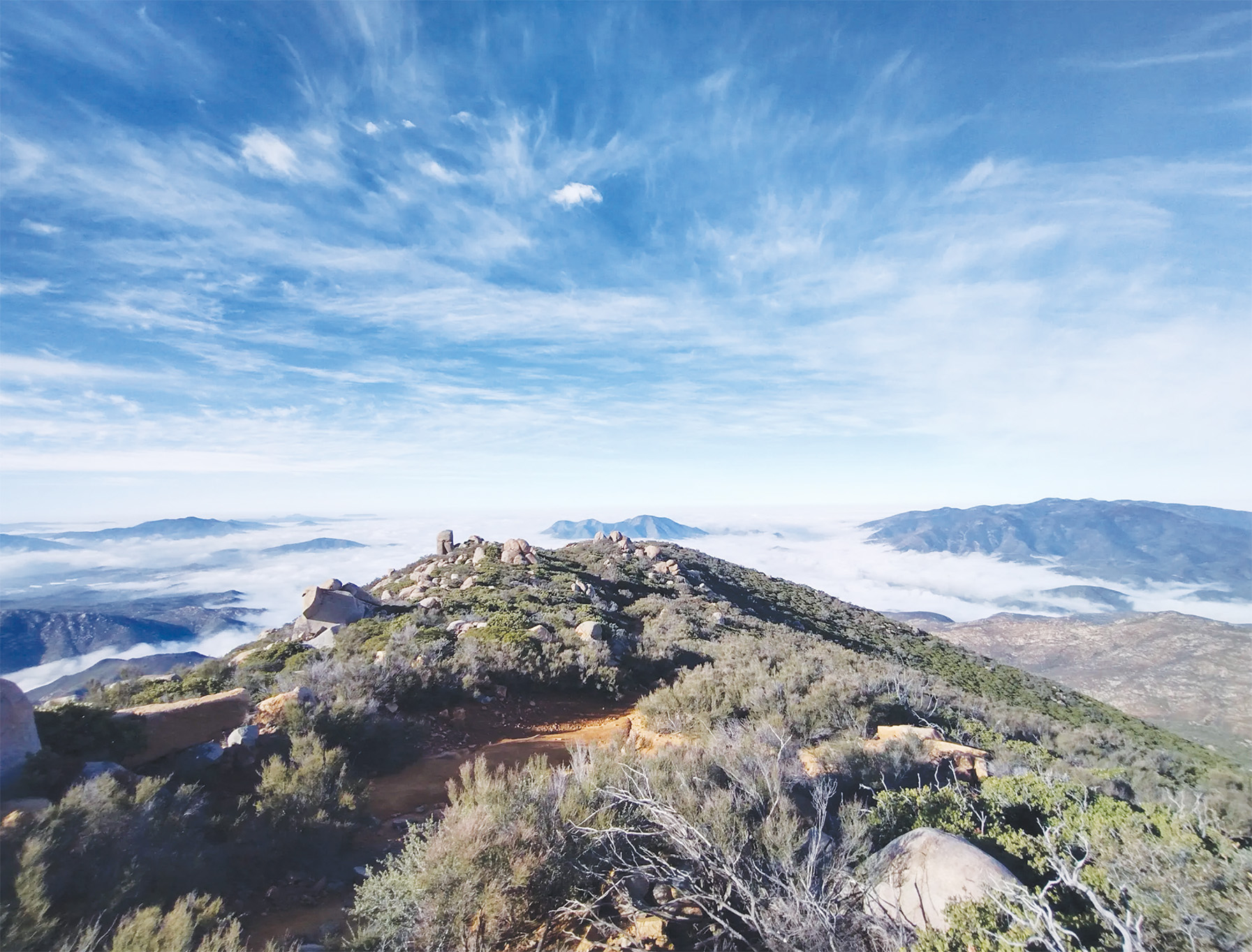
SCARS ACROSS MAGICAL AREA—Tecate is considered a spiritual center by the government of Mexico. Residents are protesting U.S. Border Patrol construction projects.
TECATE, BAJA CALIFORNIA NORTE—Tecate is a magical town.
Mexico’s government declared it to be one of the nation’s pueblas magicas, an earthly vortex of special powers like Sedona, Arizona, the Valley of the Kings in Egypt and the Atacama Desert in Chile. Magic in this context is more spiritual than the wand waving kind Americans see from Harry Potter and Hermione. Yavapai, ancient Egyptians and prehistoric Chileans identified the lands as special havens of contemplation and restoration.
Tecate’s magical mountain is currently being carved up by the U.S. Border Patrol and ICE, part of the Trump Administration efforts to fortify the border drawn by the Treaty of Guadalupe Hidalgo in 1848. It took 178 years for some Americans to realize that Cerro El Cuchumá – known in English as Tecate Peak – has its big toe sticking over la frontera.
In this border region Cerro El Cuchumá is more than a mountain. For Mexicans it is a place of memory and identity. For the indigenous Kumia (spelled Kumeyaay north of the border) it is a sacred place. More than 12,000 years before Europeans set foot on the continent, Kuuchamaa was a holy land.
DYNAMITING NOTRE DAME
Cerro El Cuchumá was declared protected forever by the Mexican government as a place of magic. On the U.S. side, the area has been listed on the National Register of Historic Places since 1993. It is recognized as a protected cultural and historical site, and an area of spiritual significance for Kumiai/Kumeyaay communities.
That has all been very literally blown away. Using dynamite and heavy equipment, Border Patrol crews have blasted, bulldozed and jackhammered roads and pathways across the U.S. side of Cerro El Cuchumá. Complaints by Native Americans, the United States Department of the Interior, the government of Mexico and environmental organizations from both nations have been ignored. Cerro El Cuchumá is being carved up like an enchilada, said an American journalist, and people of good will on both sides of the border feel helpless to stop it.
Recent detonations have shaken the area, including nearby homes – some of which have sustained structural damage. Mexican leaders have called the project reckless and cruel. Kumeyaay elders have compared it to dynamiting holy sites like Notre Dame or the Sisteen Chapel.
“We feel it inside the house,” said Professor Evangelina Guzmán, who has lived at the base of the mountain since 1982. “The walls shake. The frames move. You realize this is not something far away, it’s happening here.”
When Guzmán first arrived in Tecate the area was open and largely untouched, she said.
“There was nothing here, just the mountain,” she said. “It felt like paradise.”
Over time she saw significant changes to the landscape. Migration routes became more visible, followed by the construction of the border wall. Detonations of powerful explosives are transforming the land, said Guzman.
“It’s painful,” she said. “We lived here in a paradise, and now we are seeing it being altered in front of us.”
For Indigenous People the destruction has an additional layer of meaning, according to Norma Meza, a Kumiai cultural advocate. She described El Cuchumá as a sacred space of ancient ceremonial importance.
“The mountain is a therapist for us,” she said. “It’s where we go to process what we carry, to feel heard and to reconnect with ourselves.”
Meza described the mountain as a living presence, reflecting a global worldview that land holds spiritual value beyond its physical form.
Protection of the mountain varies depending on national jurisdiction. Cerro El Cuchumá/Tecate Peak lies about 70 percent in Mexico and 30 percent in the United States. American border agencies and construction crews are ripping across a saddle on the north face, visible for miles on both side of la linea.
On the Mexican side, Cerro El Cuchumá is considered magical and sacred. Neither designation, however, gives it any special protection. It is not protected by Mexico’s Instituto Nacional de Antropología e Historia.
NO PERMITS OR PERMISSION
Politically and practically that makes no difference. Construction is entirely on the American side. Documents obtained through the Freedom of Information Act indicate that U.S. Customs and Border Protection developed plans for border infrastructure in the area as early as 2007, including environmental assessments. Community members and advocates, however, argue that there has been no meaningful consultation with Indigenous groups. Requests to build the wall further north on the American side were ignored and the border-hugging plan was put into effect by Trump Administration Border Patrol and ICE officials.
Administration officials claim the extension of the border wall has been accelerated for “national security.” Environmental and Indigenous impacts have literally been plowed over. Border Patrol and ICE have been given virtually unlimited waivers to override the Environmental Protect Act, the Native American Graves Protection and Repatriation Act of 1990 and other constraints previously legislated or protected by court rulings.
“Trump and his gang tend to blow things up without asking for anyone’s permission,” said American journalist Sylvia Ramirez. “If and when people complain and the courts get involved, it’s already too late.”
Tecate residents worry about the impact the construction of roads and the wall will have on animal migration and hydrology.
“There is a geological impact,” Guzmán said. “We don’t know how this will affect the movement of water, the soil or the natural flow of the land.”
Citizens on the Mexican side of the border are pushing back. A grassroots group called Defensa del Cuchumá use art, public rallies and appeals to the news media to raise awareness and express concern. Christopher Martinez is active in Defensa.
“The mountain is a sacred site for the Kumiai people, but it is also important for the people of Tecate,” he said. “We are protesting because of that. This is not something we should just accept. We must come together. Only by working with others can we (effectively resist) these kinds of problems.”
Cerro El Cuchumá is a critical and fragile ecosystem for multiple species, said Martinez.
“These are not just resources,” he said. “They are forms of life that we need to respect and protect.”
Tecate writer Daimary Sanchez Moreno said Border Patrol and ICE do not see the mountain the way Mexicans and Indigenous People do.
“It’s not just a pile of rocks and dirt being destroyed,” she said. “It’s an irreplaceable pillar of identity for the community.”
Sánchez Moreno described Cerro El Cuchumá as a place of protection, wisdom and connection. Damage, she said, is forever. Guzman agreed.
“The Earth does not belong to anyone,” Guzmán said. “But we act like it does.”


