


Josh Whitehead / The SWC Sun
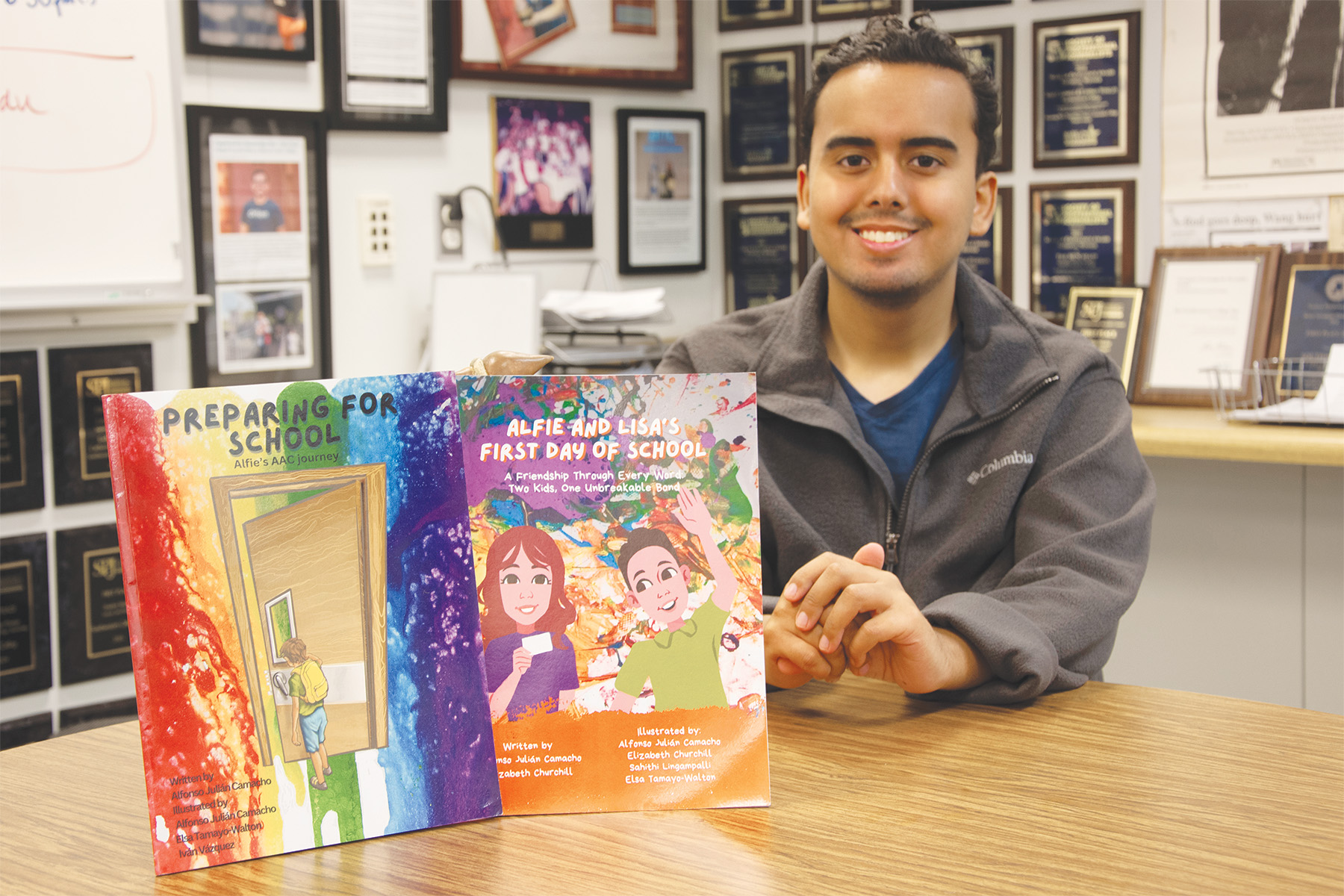
RENAISSANCE TEENAGER—Alfonso Julián Camacho has written two books about the many challenges faced by autistic students. He said more books are on the way.
By Diego Higuera
Alfonso Camacho does not speak out loud but is a champion communicator. After a church mouse quiet childhood, he is a young man learning how to roar like a lion.
Camacho, 19, uses Augmentative and Alternative Communication (AAC) to share his thoughts with others. Profound aphasia prevents him from speaking, but not from communicating. Against the odds, Camacho is the author of two books, a Comicon panelist and a frequent guest presenter.
Now he is also a national award-winning journalist.
And he has never spoken a single word…or as Camacho prefers to say, not yet.
“When I was little I had to struggle to get my basic communication needs met,” he said. “It was hard to see people give up on me from a preschool age. I am very lucky because for every expert that gave up on me, my mom found an expert that saw me. I never had an easy path, down to having to fight for silly things like learning with friends. (My first book was) an opportunity to make it right for other kids. It is the reality I would have liked that I finally found in the heart and hands of Ms. Dinusha (Perera) and her team at Montessori Explorer.”
Perera, the director of Montessori Explorer School, inspired the character Ms. Rose, the visionary teacher in Camacho’s first book, “Alfie’s AAC Journey.” Written and illustrated as a children’s book, the story follows a non-verbal child as he has an opportunity to learn about his school a month before it starts. Ms. Rose gives him the extra time and attention his needs to adjust to the new school. It was the head start that gave Alfie a chance to succeed.
“A lot has happened since then,” Camacho said, “but my heart remains grateful to (Perera) for her love.”
In Camacho’s book, the character Alfie is guided by Ms. Rose through a series of preparations the young non-verbal child will need to feel comfortable. Alfie, like Camacho, is on the autism spectrum and sometimes needs a quiet room and other accommodations to stay focused.
“I am so lucky,” Camacho said. “In my corner are many experts who shaped me and fought for me. Ms. Perera is the inspiration for Ms. Rose and Zaira Campos inspired Aida. (They) have walked this path the longest with me. Zaira was at my side through some of my most challenging moments. Ms. Dinusha is a warm home to which I can always return. They always believed in me and for that I love and cherish them.”
Camacho said he hopes the book will help other children in the autism community by showing the adults in their lives that the kids are worth the extra effort.
“I have a clear idea of what I want,” he said. “I want the lives of other disabled children to be easier than mine. I want friends to be friends more easily. (I would like to see) empathy as a default not (something that is awarded) a medal. Inclusion (should be) a norm, not a conquest.”
His top priority, he said, is for adults encountering autistic children “to feel empowered to create more equitable educational settings” for students.
Illustrator Elsa Tamayo-Walton became a collaborator. She called Camacho and his mother “family.” At first she worked with Camacho through messages, then after a while they worked in person with Camacho communicating with his tablet.
“The creative process was 100 percent Alfonso,” she said.
Walton came to learn that Camacho was “in good place” when he was “clapping,” a castanet motion he does with his hands.
“His hands move when he is emotional, concentrating and when he’s happy,” she said. “So writing this book with him and getting to know him was just – wow! The book is so relevant to so many people. I loved every second working with Alfonso.”
Camacho’s biggest fan and most ferocious supporter is his mother, attorney Nydia Celina Viloria. She is friendly as a golden retriever but can be fierce as a mother tiger when necessary. Viloria works as her son’s aid, advocate and translator. Camacho calls her his “paver of dreams” and “guardian angel.” She calls herself another mother trying to help her son.
“I experienced many emotions (throughout his life),” she said. “The coraje (anger) I would get from seeing someone give up on my child when he was way too little to be given up on. You should never give up on someone, especially when they are just three or four years old. It pushes you as a parent. It fuels that flame in your stomach. It makes you want to say, ‘Yo, hold my beer!’”
Viloria said it was frustrating to see some psychologists and educators using outdated and discredited testing models like IQ tests or other evaluation tools that did not align with autistic children.
“I remember when he was little and he had to get an IQ test,” she said. “From my perspective it was so unfair for many reasons but we had to get it done and often. (Once) a test was taking forever and I was not allowed in the room. After an hour, the assessor finally came out and said ‘I’m sorry it’s taking so long but…Alfonso (has not) made a mistake. As long as he doesn’t, he needs to keep going.’”
To say he passed his test is an understatement.
“I didn’t need a test to tell me my child could learn,” she said. “These test are very unfair because they were created for people who are able to control their motor abilities. If you have a motor disability they are actually testing your disability rather than your ability.”
Driving home that day was euphoric, Viloria said.
“The beautiful blue sky, it was so bright and sunny,” she said. “The wind felt so good blowing on my face.”
She called her mother with the glorious news.
“Mom, he passed it,” she recalled saying. “They can no longer tell me Alfonso can’t learn.”
Camacho said the story is true but his explanation was more concise.
“For me, it was just my mom being my mom,” he said.
“I did what any mom would do,” Viloria said. “We helped our kids like anyone else would. Some kids just have different needs.”
Camacho has blossomed as an award-winning college journalist and a valued member of the staff of the Southwestern College Sun and El Sol Magazine. Upon the invitation of the adviser, he joined the staff as a 17-year-old duel enrolled high school student. He has won several state and national awards for his column, features and designs. In October he won the National Ernie Pyle Profile Feature Writing Scholarship presented to him in Washington D.C. at the Associated Collegiate Press National Mediafest Convention. He is also the recipient of competitive scholarships from the San Diego Press Club and the San Diego Association of Black Journalists.
Yanelli Zavina Robles, the Editor-in-Chief of The Sun, thinks so highly of Camacho that she made him co-editor of the Viewpoints Section. She first met him when the newspaper adviser asked her last year when she was Photo Editor to sit with him and go over the Society of Professional Journalists Code of Ethics. They hit it off immediately, she said.
“I love Alfonso for so many reasons,” she said. “He is funny and has an intelligence that just radiates through a room. He has an attention to detail that is such a great skill for a journalist. I think that is one reasons he is so successful.”
Robles said Camacho is a reliable and prolific member of the Sun’s Editorial Board and an intellectual leader who shapes the voice of the publication.
“Sometimes I forget that he’s only 19,” she said. “I love his humor and his ability to make conversations enjoyable. My whole family has grown to love him. We are all Alfonso fans.”
His journalism professor said Camacho is “super smart and a precociously talented writer.”
“Alfonso is a brilliant young gentleman,” said Professor of Journalism Dr. Max Branscomb. “He is a true intellectual with broad and deep comprehension of an array of topics. He is conversant in so many areas. He is quick-witted and wickedly funny. He is a great student and I adore him as a person. I am so happy he found his way to Southwestern College and into our program.”


