


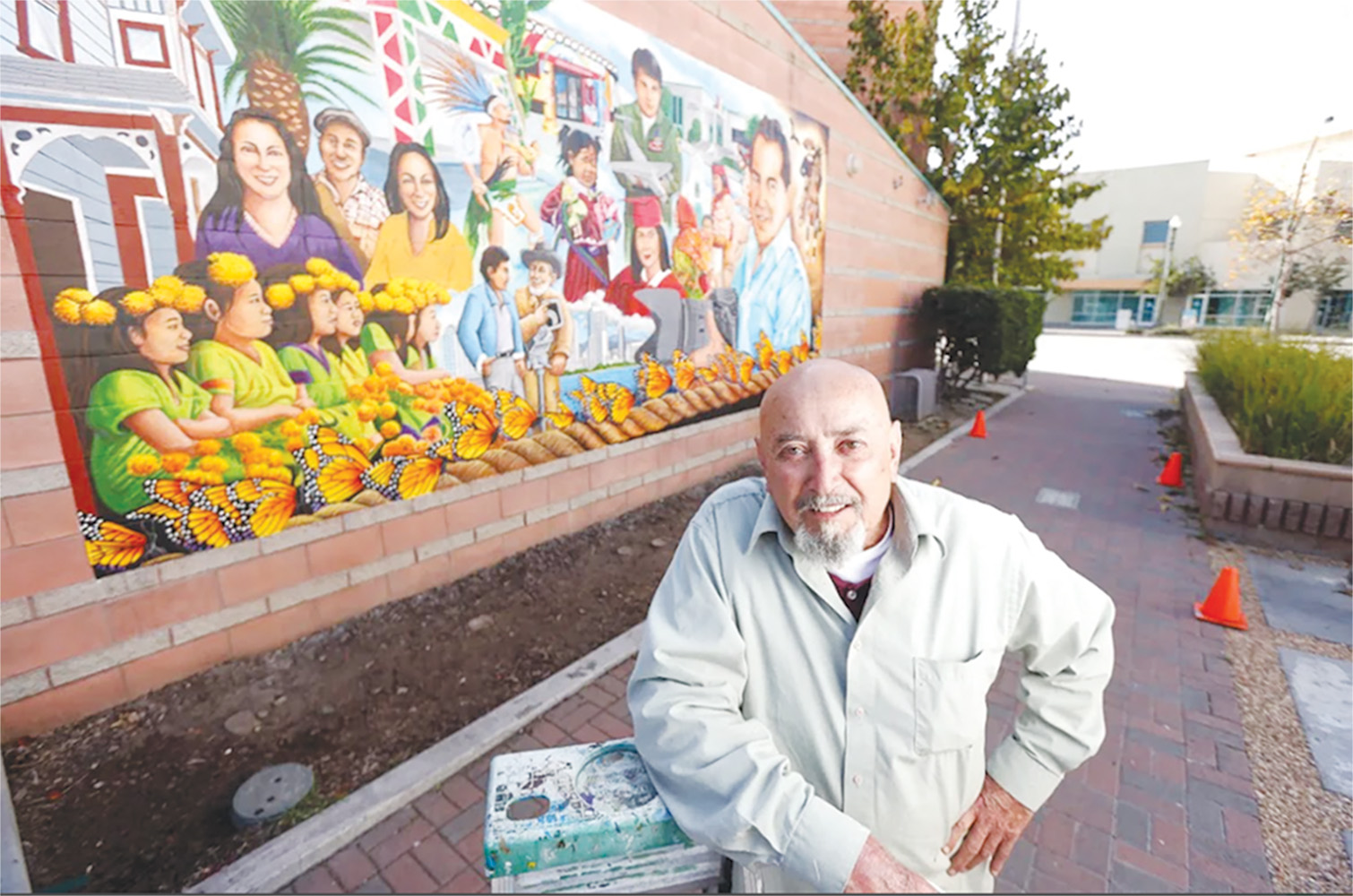
Photo Courtesy of Guillermo Aranda
Great heroes have great mentors.
Plato had Socrates.
Henry David Thoreau had Ralph Waldo Emerson.
Mickey Mantle had Joe DiMaggio.
George Lucas had Francis Ford Coppola.
And iconic Chicano muralist Guillermo Aranda had Mexican legend Gilberto Ramirez.
Aranda has had a life in the arts to rival the Mexican masters. He is considered one of the greatest muralists in the United States and a founding artist of what is now the National Heritage Site of Chicano Park. He has painted 97 murals, mostly collaborating with children and teens at their schools, recreation centers and public places.
His peers and students call him “Abuelo de murales”—the Grandfather of Murals. Granddad is not ready for the rocking chair just yet. He is currently finishing up a piece for the University of San Diego.
A National City native, young “Yermo” always liked art, but his first dream was to be a jet mechanic and work for an airline. He came from an artistic family of musicians but he said he “did not have the ear” to join the band, so he veered off into visual arts. Drawing was his forte, he recalled, and his family was supportive.
“As a people we are very artistic,” he said. “Mexicans and Chicanos have art and creativity in our blood. Painting, sculpture, jewelry, weaving, embroidery, pottery are in our DNA, going back to pre-colonial times.”
Long before Aranda met Gilberto Ramirez he met another great artist from National City, the legendary Chicano photographer Manuel “Memo” Cavada, a Southwestern College Honorary Degree recipient.
“I went to kindergarten with my good friend, Memo Cavada,” he recalled. “As kids we tried to fill our pockets with our opponent’s marbles. In high school we dated a pair of sisters and went out on double dates. I was in the Air Force and he was in the Army at the same place. We reminisced about it all the time. It was a lifelong friendship.”
Following his military service, Aranda used his GI Bill funds to attend San Diego City College where he studied for a license to become a jumbo jet mechanic. That career never took off.
“I walked by the art department every time I went to class,” he said. “I would stand at the windows looking in at the students. I realized that’s what I wanted to do. I changed my major to art.”
It was the right call for the gifted illustrator and painter. He transferred to San Diego State University and became active in the Civil Rights and Chicano movements. Ramirez spotted Aranda in 1970 at SDSU. It was an era of upheaval and rebellion as students protested the Vietnam War and Chicanos demanded better treatment in America. Chicano Park was birthed in this epoch, as was the Centro Cultural de la Raza in Balboa Park.
Maestro Ramirez had his own uber-mentor, Mexican master David Alfaro Siqueiros, one of “Los Tres Grandes,” Mexico’s Mt. Rushmore of muralists that includes Diego Rivera and Jose Clemente Orozco. He saw in Aranda what Siqueiros had seen in him. Ramirez rocked his world, Aranda said, and changed his perspective on art. Murals became his mantra.
“During the fall of 1969, Ramirez came to San Diego to see what was happening in the local Chicano Movement,” said Aranda. “I spent every moment before, between and after classes working with him. I learned about his technique, his approach, how he did everything. Before Ramirez all I knew was paint on canvas. He showed me the concept of mural painting and it fascinated me.”
SDSU commissioned Ramirez to paint a three-part mural originally called “Amanacer” (the dawn.) He brought in Aranda and community college artist Ruben DeAnda to assist with the creation now known as “Triptico” (Spanish for triptych, a three-paneled work of art).
Aranda and DeAnda received a master class from the classics master. Ramirez taught them what Siqueiros had taught him about sketching, plotting and painting large scale murals. He divided up the labor for the trio of 20’ by 12’ panels and never stopped teaching.
“Ramirez constantly talked about Mexico City,” said Aranda. “He urged us to go see the murals of Siqueiros, Rivera and Orozco in person.”
“Amanacer” was completed in January 1970. Nearly a year later, on December 7, 1971, the San Diego Union announced the completion of “Triptico” in an article titled “S.D. State Unveils Mural to Honor Chicano Crusade.” The first panel, “Crespusculo,” illustrates the near-destruction of the culture of Mexico’s indigenous people. “Noche,” the middle panel, emphasizes the border separating Mexicans and American Chicanos who are estranged from their heritage. “Amanacer,” the third panel, is a hopeful dawning of a new age.
Art historians consider the trilogy the region’s first great Chicano mural.
“To understand a mural is to understand the context of time,” said SDSU Chicano(a) Studies Chair Dr. Norman Iglesias-Prieto at the unveiling. “Murals are like a graphic textbook. ‘Triptico’ is the epitome.”
Aranda did not take long to start on the region’s second great Chicano mural, “La Dualidad,” though he took a long time to complete it. He took his mentor’s advice and traveled to Mexico City to study the great murals of Rivera, Orozco and Siqueiros.
Chicano artists had recently been given tenancy in an abandoned circular water tank on the southern edge of Balboa Park. Aranda began to paint along the curving wall of what is now the iconic Centro Cultural de la Raza.
“When I came back to San Diego, I reworked my drawings and started working on the wall of El Centro,” he said.
Many young artists helped him, including Neto Paul, Guillermo Rosette Chavez, and David Avalos. They also painted murals at the San Ysidro Teen Center and in Placentia, near Fullerton.
“La Dualidad” (the duality of life) was, fittingly, created in two efforts whose start and finish were separated by 13 years. He worked feverishly on the ambitious project from 1970 to 1975, often falling asleep on paint-splattered tarps with his wet brush in hand. He was pulled away from the project for years to serve as director of El Centro Cultural de la Raza, chair the arts collective Toltecas en Aztlan and to help create MAYA (Mexican-American Youth Organization).
But he never stopped thinking about “La Dualidad.”
Ramirez journeyed to el norte periodically to check in on his protégé. Aranda and assistant Neto Paul said Chicanos good-naturedly needled Ramirez about spending so much time in San Diego rather than with the aging legend Siqueiros in Mexico City.
“Better to be the head of a mouse than the tail of a lion,” he intoned.
A January 1984 article in the Chula Vista Star-News trumpeted “13 Years Later, NC Artist Finishes His Mural.” “La Dualidad,” a Chicano art masterpiece, was complete.
It wasn’t like Aranda was sitting around all those years. In 1972 he led of team of artists to realize an idea by Neto Paul titled “Our History” at the San Ysidro Recreation Center. It was a tune up for one of his famous works, the legendary Founder’s Mural in Chicano Park. Aranda teamed with Paul, Salvador Barajas, Arturo Roman and Rosette–four young artists who are now Chicano icons.
In 1973 he painted the mural “Fuerzos Naturales” at the Tlatepague Restaurant in Placentia, assisted by Paul and a groups of eager students from UC Irvine later known as “The Santa Ana Artists.” Later that year Las Toltecas began painting murals in Chicano Park. Aranda, Barajas, Arturo Román, Paul and Rosette were among the artists who launched the project that would change art history in the United States.
“When you look at the murals on the walls at Chicano Park, it is easy to imagine beautiful images on the pillars and embankments,” said Aranda. “There were a lot of artists who talked about it, but Toltecas en Aztlan were the ones who did it first.”
After securing funding, Toltecas en Aztlan sought a permit from CalTrans to paint city retaining walls under the Coronado Bridge. CalTrans officials told them it would take at least six months to process a permit, so they said “chale!” and started without one.
No one stopped them. More than 300 volunteers showed up, armed with paint and brushes. Unfortunately, Aranda recalled, many went rogue and painted a lot of silly, random things on the pillars. On the day of the third anniversary of the founding of Chicano Park Logan Heights activist José Gomez approached Aranda with a scowl.
“Guillermo,” he scolded, “see what you guys have done?”
Aranda just chuckled.
“I told him we were not done yet.”
Las Toltecas en Aztlan painted over the “placasos,” gang graffiti like “Ruben the Sanjo was here.” Aranda encouraged the artists to look hard at the walls like Michelangelo looked at an untouched block of granite.
“What can you pull out?” he asked them philosophically.
Artists painted furiously through the summer and into the fall, “discovering the spirit of the walls.” Chicano Park began its transformation from an unsightly hoard of graffiti to the largest outdoor mural collection on the planet earth and a sublime national treasure.
A year later Aranda invited the Santa Ana Artists to Chicano Park to paint the first pillar. “Hijo del Sol” was completed in 1974. Two embankments were painted in the first year.
In 1975 the fun-loving and immensely talented artistic band that called itself the Royal Chicano Air Force flew in from Sacramento. The Royal Chicanos painted the park’s third and fourth pillars. At the same time Aranda teamed with Barajas, Paul and Roman to paint murals on the outside of the Centro Cultural de la Raza.
“The influence of Yermo Aranda is enormous,” said Barajas, the 2021 Southwestern College Honorary Degree recipient. “We would not have Chicano Park the way it is now without him. He has had a great life as a muralist and a teacher up and down the state of California.”
Barajas and Aranda teamed up in 2021 on an emotional project–a tribute to their compadre Memo Cavada who had died a year earlier of COVID. Painted on the northern wall of the National City Chamber of Commerce building, the 10’ x 22’ piece features colorful images of Cavada’s photos as a Mexican cultural preservationist and a community philanthropist. A legion of San Diego County’s greatest Chicano leaders, educators and artists jammed into an adjacent square on a blustery December day to dedicate the mural.
“It is always a great honor to work with Yermo,” said Barajas. “He is a gifted artist and a very generous man. He has made a great impact during his lifetime.”
Aranda said was blessed with several influential teachers.
“My greatest mentor is Salvador Roberto Torres,” he said. “He helped me to delve into exhibiting. We created artist organizations (for young painters). I’m still working with art students as a mentor and teacher. I hope that (painting) a wall fills my students with enjoyment, fulfillment and the sense of completing the impossible.”
Aranda said he is a rare person who enjoys facing a wall.
“I love mural painting,” he said. “It gave me a life and financial stability. The Chicano Park murals are probably the best of all.
Obi-Wan Kenobi mentored Luke Skywalker who mentored Rey Palpatine. Barajas said Aranda is part of a powerful chain of teaching and learning that started with Siqueiros and has spread through Aranda to thousands of younger Chicanos.
“My art came from the inspiration, the excitement, the love and the fire that Gilberto Ramirez ignited in me. It’s still a good time to be a muralist!”


