


Josh Whitehead / The SWC Sun
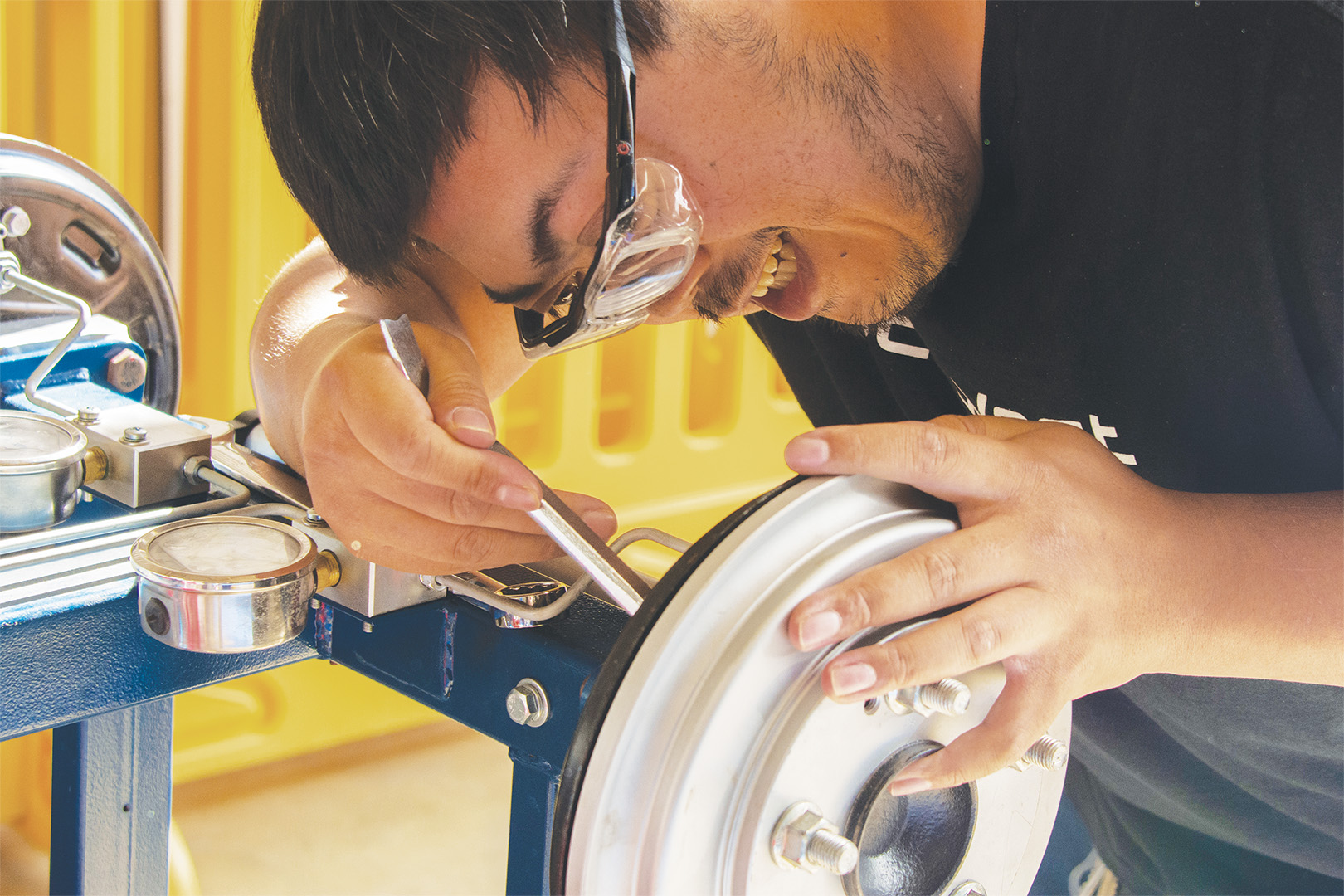
BRAKE OF A LIFETIME—Southwestern College students can learn in a state-of-the-art automotive technology center.
By Nena Lopez
Class was in session and Yessenia Martinez was head down, cranking away on the problem.
There was not a math book in sight.
Martinez had her head under the hood of a Ford. Her hands were greasy, but her radiant smile was pristine. She was in her element in the garage.
The Southwestern College Automotive Technology program is humming along like a new Audi A4 and packing them in like a Chevy Suburban.
Martinez said she loves being an automotive technology student.
“I came in knowing nothing about vehicles, but here I’ve learned a lot and really understood the material,” she said.
Martinez said she felt comfortable asking questions, even in a garage full of guys in a field that is male dominated. Professors are welcoming, she said, and find time for individual attention.
“You get each instructor’s lived experience,” she said. “It is like having a mentor one-on-one.”
Each instructor is industry certified with extensive automotive experience. Martinez said she especially enjoys the two hours of hands-on lab work.
“The time goes by quickly,” she said. “We get experience with different systems and vehicles. I really like working on older cars. My favorite is the Ford Ranger.”
Lead instructor Brian Palmiter said the program is designed for all comers.
“We have beginners who just want to understand their cars to those pursuing a full career as technicians,” he said. “We’ve doubled in size since COVID from about 500 to around 1,000 students a year. We’re one of the biggest programs on campus.”
SWC’s automotive area spans almost 60,000 square feet, making it one of the largest college facilities of its kind. Palmiter said the college has invested millions of dollars into updated equipment and tools, providing students industry-standard technology.
Students work on real vehicles and training models designed to simulate specific automotive systems.
“Automotive is very much based on what you can do,” Palmiter said. “Our students can do anything that’s mechanical and can work at dealerships, shops, the Port of San Diego or transit systems. We try to connect students with real jobs, so we make sure they are ready.”
Punctuality and professional habits are important to employers, Palmiter said, so he emphasizes those traits.
“If you are late to work in this field it effects customers and schedules,” he said. “We try to teach students the expectations of the industry.”
Students can earn valuable Automotive Service Excellence (ASE) certificates for specialized areas such as brakes, engines, transmissions and electrical, Palmiter said.
“The more ASE certificates you have, the more it can impact your pay and opportunities,” he said.
Randy Beach is co-director of the Competency Based Education (CBE) program, a technical and career based approach.
“You don’t really enroll in classes, you enroll in a program and move through competencies at your own pace,” he said. “You don’t really enroll in classes, you enroll in the program and move through competencies at your own pace.”
Palmiter said he is passionate about his career.
“I just want to help people to succeed,” he said. “There’s good money in this field if you work for it. I like to take what I know about automotive and combine it with how students actually learn.”
Martinez said the program has ad an immediate and positive impact on her life.
“When I answer calls at work I recognize what they’re looking for now,” she said. “I can identify parts and understand what mechanics are asking for.”
She is living prove that women can thrive as mechanics. Her next big goals is to become a master mechanic, the open her own shop.


