


Jose Whitehead / The SWC Sun
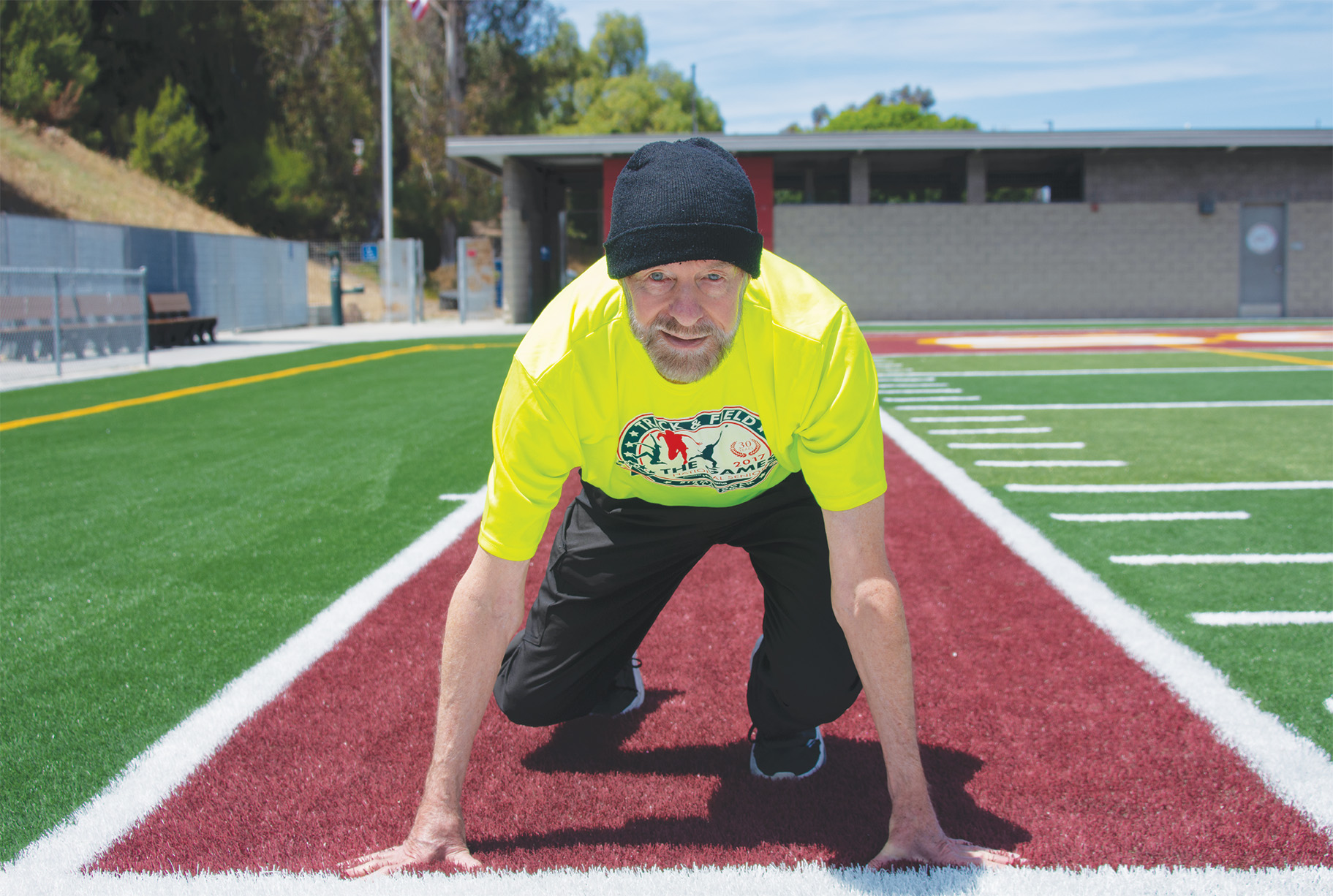
NEED FOR SPEED—Mathematics instructor Bruce Underhill is an age group track and field champion and America’s #2-ranked senior division triple jumper. He recently won five gold medals and a silver in competition. Underhill is also an activist fighting world hunger and poverty.
By Dana Sharai Little
Most mature gentlemen like mathematics instructor Bruce Underhill have retired to the backyard, rocking in the chair.
Not the retiring type, Underhill is rocketing around the track.
Southwestern College’s Renaissance Super Adjunct is an age group track and field champion in multiple events. Underhill recently won five gold medals and a silver. He is a sprinter and America’s #2-ranked triple jumper — a hop, skip and jump away from national champion.
Underhill is senior enough to collect Social Security but has no plans to retire from teaching or competing. He is a regional leader in the development of effective mathematics curriculum and could probably give even his most athletic students a run for their money.
In high school Underhill played football and tennis, “but always kind of liked track.” He ran to stay healthy and decided he might like to try competing. His workouts and training are important, he said, but a book unexpectedly changed his life and his trajectory as an athlete.
“I started reading about meditation and that really intrigued me,” he said. “In theory if you can visualize yourself doing something, that tells your body what to do. Visualization gives you the instructions and that enables you to do it.”
A positive mindset is essential when it comes to exercise, he said.
“If your mind is full of doubt and thinking that you can’t do it, that’s the message that gets sent to your system,” he said. “Your body conforms to that image and you don’t perform well.”
Underhill’s athletic career was greatly influenced by Paramahansa Yogananda, the leader of the Self Realization Fellowship.
”He taught me the principles of yoga and meditation,” he said. “I think that changed my whole relationship with everything I do.”
Competitions can be stressful, Underwood said. Doubt can creep in.
“For me meditation was an experiment, then a discovery,” he said. “One night I was meditating and I felt stresses disappear. I felt better about being me.”
RACE AGAINST WORLD HUNGER
Underhill is also in a life-and-death competition against the spread of world hunger and poverty. In 1984 he joined RESULTS, a non-governmental organization. Cutbacks by the Reagan Administration pushed millions around the globe into adject poverty and malnutrition. More than 1.2 million died in Ethiopia alone.
Underhill and his friend Sam Daley Harris worked hard to raise awareness by asking newspapers across America to publish editorials calling attention to the problem. They also lobbied the United States government to have wealthy nations grant relief money directly to human services organizations rather than other governments, especially kleptocracies that stole some or all of the aid money.
“Instead of just giving the governments aid money and hoping that something good happened, we targeted the money so that it was used for healthcare, education and this thing called micro credit. The idea of microcredit are very, very small loans to the very poorest of the poor. They then use that money to start little businesses that can elevate themselves and others.”
LOVING ADVOCATE FOR STUDENTS
Underhill moves quickly around the track, but he takes his time when it comes to helping students, said his longtime friend Andrea Patton.
“Mr. Underhill is extremely dedicated to the well-being of his students,” she said. “As far back as I can remember he was always talking about having papers to grade. I was a child at the time and just wanted to play, yet somehow he managed to make time for my sister and me despite the workload waiting for him at home.”
Patton said Underhill never cuts corners.
“I remember encouraging Bruce several times to use Scantron tests instead of grading each one by hand,” she said. “He wouldn’t have it. He feels strongly about reviewing every math problem to determine whether a student deserved partial credit for getting the steps right, even if they made a mistake along the way. He also used this as a teaching opportunity to ensure his students were truly learning the material, not just arriving at the correct answers.”
Math students appreciate Underhill’s dedication, Patton said.
“He genuinely cares about others and their success, even when it requires sacrificing his personal time,” she said.
When he is not triple jumping, sprinting or grading papers, Underhill said he likes to stay active outdoors hiking, playing golf, riding his bike, playing tennis or shooting hoops.
“He can also be found on the dance floor, kicking up his heels—literally,” said Patton. “Bruce’s accomplishments span both his professional and personal life. But most important of all is the fact that he is a kind and caring human being. What more can be said to honor such a man than congratulations for living life
to its fullest?”
Underhill said teaching mathematics is important because American students are having an increasingly more difficult time with the subject.
“We don’t give enough attention to math instruction when the kids are young,” he said. “Community college is very important because it is a chance to catch up and master mathematical concepts that they will need to succeed in so many professions.”
Underhill said he is happy to have the opportunity to help keep math students on track.


