


Photo Courtesy of Geoffrey Yeager
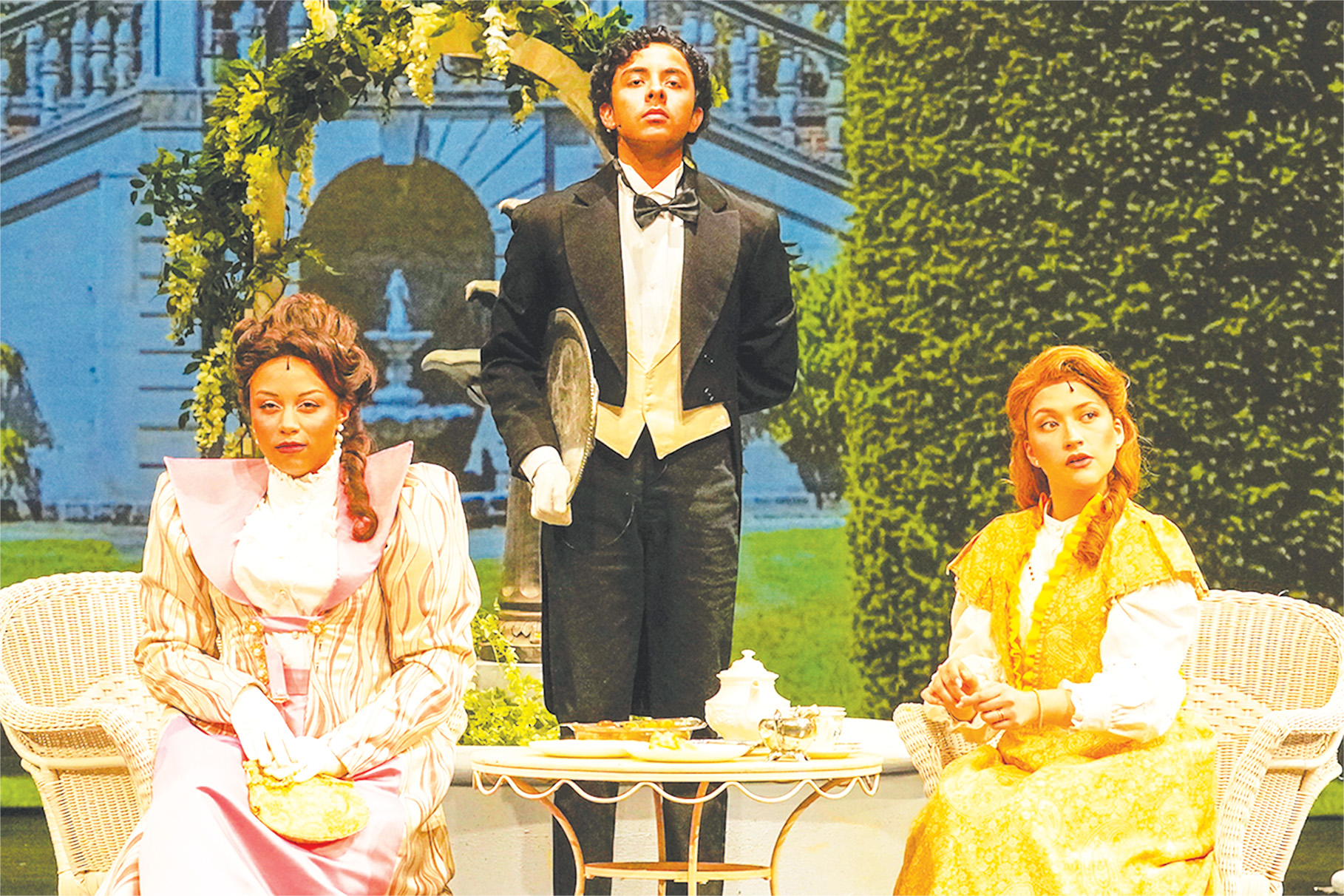
‘OLD-FASHIONED RESPECT FOR THE YOUNG IS DYING OUT’—Snarky, witty Gwendolyn (Dacara Seward) at first does not care for lovely Cecily (Montse Cabrera), but the rivals bond over time.
Playwright Arthur Miller went for the conscience, William Shakespeare for the heart and Sam Shepard for the jugular. Oscar Wilde always went for the funny bone.
“The Importance of Being Earnest” is a reminder why we need to rehear the wickedly luminescent words of the smirking, subversive playwright and why meaningful college theater programs need to produce the greatest works by history’s greatest writers. It is particularly so during the post-truth, flood-the-zone era we are slogging through.
Wilde’s wild romp set in 1895 London could have been 2026 Mar-a-Lago where the unthinking can drown in the shallowness. Director Ruff Yeager and his talented team put wind in Wilde’s billowing sails with a brilliant production of a deceptively difficult theater classic.
Opening with a blowout of color in the ritzy London towne house of bon vivant aristocrat Algernon Moncrieff (a delightful Daniel Salva), the audience soon realized it was embarking on a high energy cocktail of French theatre de l’absurde and “The Big Bang Theory.” Wilde lets on right away that his characters are all flawed. Or fraud.
And there the fun begins. Wilde’s frolic lampoons poorly-educated, entitled aristocrats, snobby classism, economic inequity, underserved status, flaunted privilege by doltish nobles, sexual repression and preservation of rigged political and economic systems. Landed rich hold all the cards and scarf down all the cucumber sandwiches, leaving crumbs for the unwashed masses that rarely get a mention in the sitting rooms and formal gardens of the Victorian “Empire Where the Sun Never Sets.”
Wilde had to be careful not to take things too far, or to at least disguise his rants as innocent comedy. Act I was a stewpot of symbolism dressed up for laughs as Algernon and his rakish pal John Worthing (suave Cody Ziemer) chase around the room and climb on the furniture like little boys in a game of keep away. Barbs fly faster and funnier when stately Lady Bracknell (Dagmar Krause Fields) and her winsome daughter Gwendolyn Fairfax (Dacara Seward) enter the scene. Things start badly when Lady Bracknell learns there are no cucumber sandwiches and gets worse when she denies Jack fair Gwendolyn’s hand in marriage after a snobby pranging.
Wilde jabs his English forebearer Shakespeare, who famously wrote “What’s in a name?” Unlike Juliette, for Gwendolyn the name is everything. She would only marry a man named Ernest because it “inspires absolute confidence.” Seward walked a skilled actor’s tightrope, creating a character who was hopelessly self-absorbed but likeable.
Parallels to American malignancies of the 21st century popped through Wilde’s double-sided dialogue like weeds in the White House rose garden before it was run over for a new ballroom. The “let them eat cake” attitude of the superrich resonates in the Age of Musk, even if “cake is rarely seen at the best houses nowadays.”
Wilde’s never-seen mystery character Lord Bunbury is Algernon’s fake invalid friend in the country and a convenient excuse to escape the suffocating strictures of London high society. Ernest and Bunbury may have been coded references to the LGBTQ community of the time, which of course, was scorned and outlawed. In “Earnest,” however, Algernon has to play it straight as he pursues Jack’s ward, the lovely ditz Cecily Cardew (gifted Montse Cabrera). It is hardly a spoiler to predict a double wedding in Act III as Wilde rolls out enough plot twists to braid rope.
Yeager brought a deft touch to his “Earnest,” stirring just enough daftness into Wilde’s literate dialogue. Less disciplined directors often spoil the play by leaning too far into silliness and easy gags, not giving the luxuriant language the space it needs.
The cast was marvelous, well-rehearsed and marinated in chemistry. Dagmar Fields, the polymath 80-year-old Southwestern College English Professor Emeritus, was brilliant as Lady Bracknell and set the bar for her younger castmates. Her grand entrance was worthy of Mick Jagger at Glastonbury. Lady B was a pompous bag of hot air that floated like an elegant dirigible. Audience members smiled and took a deep breath in anticipation of the snooty fun that was coming. Her haughty interrogation of Jack was hilarious and revealing, especially when she rejected him as a suitable husband because he was found as an infant in a handbag at a railway station.
Cabrera—electrifying as Gloria Estefan in last year’s musical “On Your Feet!”—disappeared into the role of sweet, gullible Cecily. A triple threat chameleon, Cabrera has been a treat for Southwestern College audiences ever since her charming and kind Miss Spider in “James and the Giant Peach.” She pushed her Big Four team of Ziemer, Savala and Seward up a notch and bound together a story that can be a bad read or two from flying apart.
Peng Wang, Fernando Meriman and Walker Flores, in the category of “there are no small parts, just small actors” all came up big in their limited time on the stage, sprinkling a dash of spicy curry on the main meal.
Set designer Julie Lorenz had big shoes to fill stepping in for San Diego County design legend Professor Michael Buckley who is on sabbatical, and she did so with an impressive three-scene staging. Her backdrops were towering and imposing in the nature of Victorian manners, while also colorful and quite lovely.
A witty, elegant and enduring comedy, “The Importance of Being Earnest” remains one of the greatest plays in English literature. Yeager’s cast and crew gave it the royal treatment it deserves.


