


Josh Whitehead / The SWC Sun
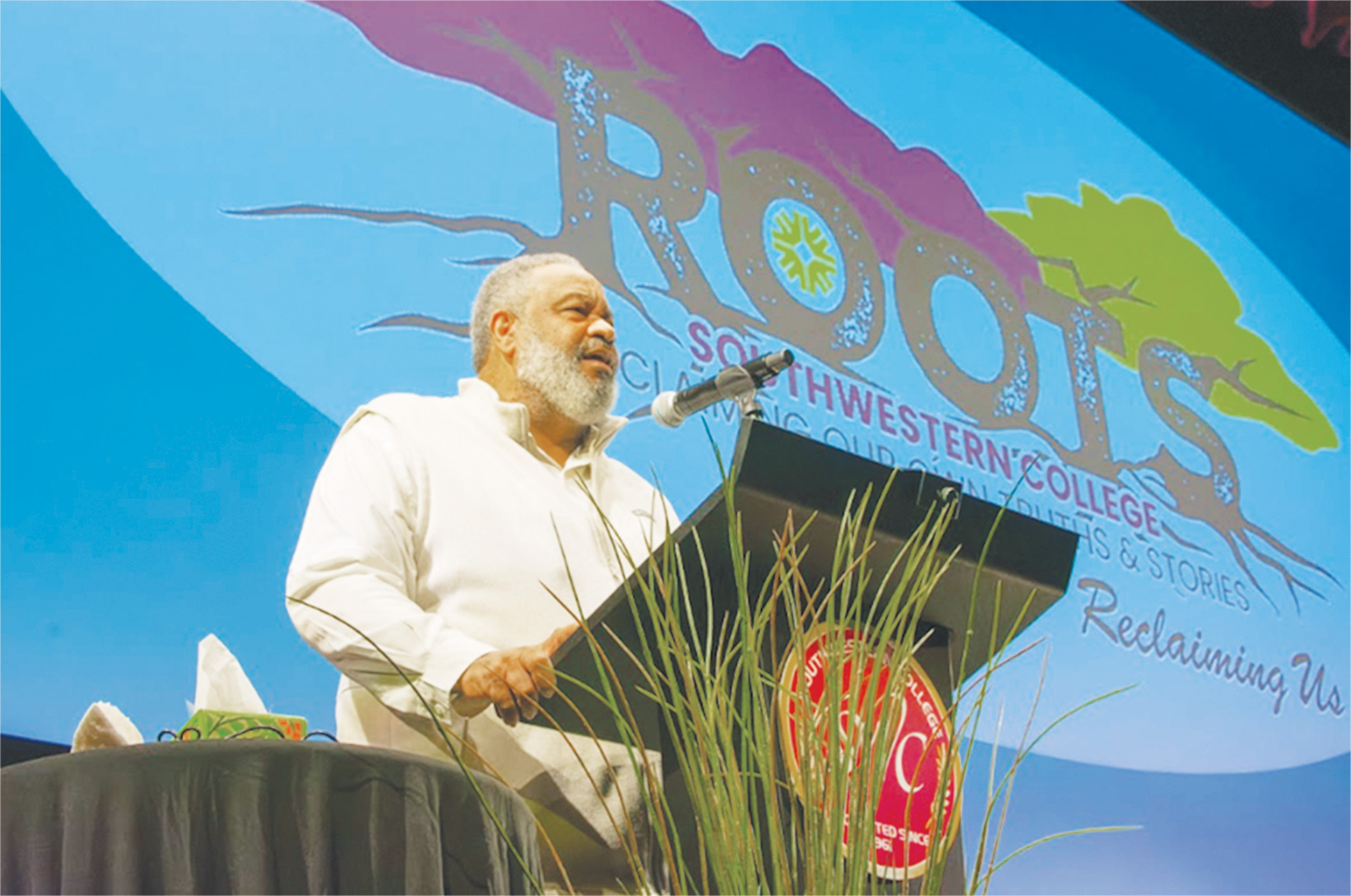
GUILTY OF BEING BLACK—Anthony Ray Hinton was falsely convicted of murder in Alabama and spent 30 years on death row. He spoke at SWC against capital punishment.
By Alfonso Julián Camacho
It was a sickening odor.
Death’s stench from seared human flesh wafted from Alabama’s electric chair like a cruel invisible reaper reminding Anthony Ray Hinton that he would soon be given his final seat in the “Yellow Mama.”
Hinton’s cell in the solitary confinement area of Alabama’s Death Row was adjacent to the chair that one by one electrocuted members of the prison book club he founded. The day came when he was the last living member.
Determination and luck saved Hinton. After 30 years on Death Row following a wrongful conviction for the murder of two fast food restaurant workers in Birmingham, he was cleared and released from prison. His life is a cautionary tale about the stubbornly persistence of racism in the law enforcement and legal systems of the American South that still haunts Black Americans, particularly Black men.
MOWING WHILE BLACK
Hinton’s three-decade nightmare and last-minute escape from The Chair started during the summer of 1985 when he committed the crime of “Mowing the Lawn While Black.” He was also guilty of being young and poor.
On a placid rural Alabama evening Hinton was cutting the grass when two plain clothes Birmingham Police detectives pulled up.
“Are you Anthony Ray Hinton?” one asked.
Unaware that his life as he knew it was about to end, Hinton said yes. He was handcuffed and arrested for the February 25 and July 2, 1985 murders of John Davidson and Thomas Wayne Vason.
“My mama shouted, ‘What are those handcuffs doing on my baby?’” Hinton recalled during his compelling presentation at Southwestern College. “They later said it was for murder, but I felt relief. I was at work at the time of the crimes.”
Being innocent and nowhere near the murder scene was no defense in Jim Crow Alabama. Birmingham police detective Doug Acker bluntly told Hinton, then 29, how it was going to go down.
“The detective said to me, ‘I don’t care what you did or didn’t do,’” Hinton said. “‘I am the one who will make sure you are found guilty. There are five things that are going to convict you: One, you are black. Two, a white man will say you shot. Three, you are going to have a white prosecutor. Four, you are going to have a white judge. Five, you are going to have an all-white jury.’”
SHODDY DEFENSE
His public defender was not much of a defender and indicated right away that he was not going to make much of an effort to help him.
“Listen, all y’all always doing something and saying you’re innocent,” Hinton recalled public defender Sheldon C. Perhacs telling him.
The prosecutor was also a legal bumbler, but Hinton faced a white wall of predetermination. The Jim Crow fix was in. Truth did not matter nor did the state of Alabama let the facts interfere with its deadly story.
Hinton’s boss testified that he was with him at work during the time of both murders, but the disastrous testimony of an incompetent defense “special ballistics expert” sealed his fate.
Attorney Aaryn Urell, 50, a senior attorney at Equal Justice Initiative, was fresh out of law school when she first worked on Hinton’s case. She said the entire case was a pig circus—a deadly one.
“Alabama, in fact, was in crisis,” she said. “People were executed without any legal assistance. Alabama has one of the highest execution rates in the country. And at the time (Equal Justice Initiative was) founded, a quarter of the executions taking place in the United States were happening in Alabama. Alabama also consistently has one of the highest death sentencing rates in the country.”
Until recently an elected judge in some states could override the jury’s decision and order the death penalty. Alabama is the only state where that was common. Alabama also allows death sentences from non-unanimous jury verdicts. About 80 percent of the people on Alabama’s death row would not have been sentenced to death in any other state because the other states require a unanimous jury verdict for death.
Hinton’s defense attorney, Perhacs, was no help. He was as biased and corrupt as the rest of the system that he served.
“The (defense) lawyer made a mistake,” said Urell. “He did not examine Alabama law fully. He said he thought he could only get $1,000 for an expert (witness), which was not true. Because he thought he could only get this much money instead of hiring a forensic firearms investigator, he got this retired civil engineer who had no training or experience in forensic firearms identification. He didn’t even know how to use the microscope and the prosecutor just destroyed his credibility on the stand. And, in fact, the state forced him to admit on the stand that he had only one eye. (Prosecutors) ended up mocking him as a one-eyed charlatan who was no expert at all.”
The defense attorney’s incompetence and insufficient effort triggered a death sentence, said Urell. Hinton’s charges were elevated to two counts of first-degree capital murder. Death was the punishment. At sentencing the judge mumbled, “We did not get the right nigger today, but at least we got a nigger off the streets.”
For 30 years, Hinton sat on death row. He spent decades in solitary confinement. His imagination was his saving grace.
‘I MARRIED HALLE BERRY’
Like Valentin in “Kiss of the Spider Woman,” Hinton burrowed deep into his imagination to build a fantasy life that fueled his will to survive.
“I got myself a wife, but not just any wife,” he said, tongue in cheek. “I married Halle Berry. We stayed married for 15 years. She was the perfect wife. She didn’t say nothing but ‘yes, dear.’ Then I laid eyes on Sandra Bullock…I had to give Halle some sad news.”
Hinton said his mother always believed in his innocence. She visited him regularly until she died. Hinton eventually asked Brian A. Stevenson to represent him on appeal. Stevenson agreed.
Hinton said he told Stevenson what he needed in an expert.
“Steve,” he recalled saying, “not only does he have to be White, he has to be a White male and he has to be from the South. I lived in the South all my life. (White people in) the South will only recognize one of their own.”
Stevenson secured three Southern ballistic experts. All were primarily prosecution experts, unflinching in their commitment to the truth. They all confirmed that the gun did not even come close to being matched and that the prosecution’s case was built entirely on manufactured evidence. No matter. The Alabama court system refused to review Hinton’s file. Even after his conviction was proven a sham, he spent 12 more years in prison.
Urell said Hinton finally got a break.
“It took the United States Supreme Court, in this incredibly unusual posture, to issue a unanimous order in 2014, which was not actually about the innocence claim, but about the ineffective assistance of counsel,” she said. “They found that Hinton’s trial counsel was constitutionally ineffective for failing to hire a proper expert and for failing to realize that the law provided funding for that. It was only because this extraordinary thing happened at the United States Supreme Court that we were able to ultimately get relief.”
FREE AT LAST
On April 3, 2015 Hinton was released from the Holman Correctional Facility. He was finally free.
“I sat on death row for 30 years, not because I had committed a crime,” he said. “I sat there because I was born Black and poor. The State of Alabama knew that they could get a conviction because I didn’t have the money to hire a decent defense.”
Hinton is now a fierce opponent of the death penalty. He travels the world advocating for procedural rights and abolition of capital punishment. His visit to Southwestern Collage filled the Performing Arts Center. He has reason to be angry but he insisted he is not a bitter man. He has worked to forgive his tormentors and liberate himself from anger and vengefulness, he said. It is not his job anyway.
“Everybody that played a part in sending me to death row, you will have to answer to God,” he said.
Atlee Contreras Urquhart, 41, an administrative secretary at Southwestern College, said she jumped at the opportunity to drive for Hinton during his visit to the college.
“His demeanor put me at ease,” she said. “It felt very familiar, like somebody that could have been a part of my family. I was very impressed by his calm and his still energy. He is wonderful to be around. His (death row) experience inspired him to love everybody around him. He can no longer bring himself to feel hatred or have vengeful feelings towards anybody.”
Contreras said she was touched by his final message: “Everybody is somebody’s baby.”
Bryan Stevenson, Hinton’s lead attorney from the Equal Justice Initiative, said one of every eight people executed in the U.S. was later found to be
not guilty.
“If one of every eight planes that took off crashed,” he said, “nobody would fly.”
The State of Alabama, despite its three decades of bumbling, judicial misconduct and blatant racism, has so far refused to compensate Hinton for the 30 years he was unfairly imprisoned. His $1.5 million claim against the state—a mere $50,000 for each year he was incarcerated following a wrongful conviction—was rejected by the state legislature. Authorities said he did not prove his innocence.
A FORM OF LYNCHING
Hinton was gentle and relaxed during his backstage interview following his presentation, but emotion welled up when he spoke about capital punishment.
“It is a form of lynching,” he said. “The death penalty is a form of lynching Black and Brown men.”
Hinton has been recognized for his work promoting fairness
in the American judicial system and abolition of executions.
He has received honorary doctorates from St. Bonaventure University and Emory University. Freedom and validation is sweet, he said, but never enough to erase the acrid smell of Alabama’s Death Row.


