


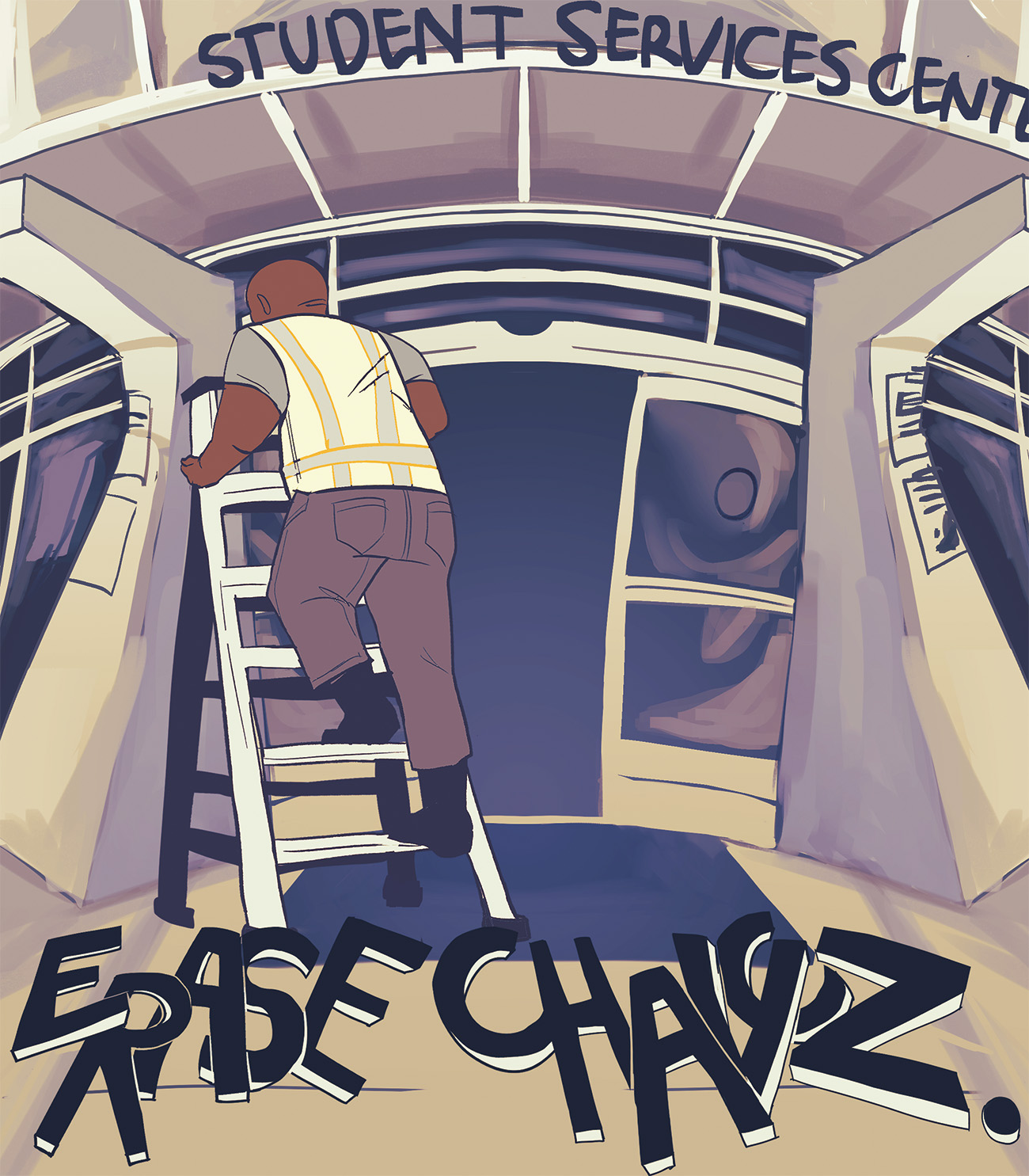
Illustration By Carla Labto / The SWC Sun
When the allegations against Cesar Chavez surfaced, the response from the Chicano community was immediate.
There was no hesitation. No waiting period. No collective silence.
Instead, there was support for the victims.
And that matters.
In a culture where victims of sexual abuse are often dismissed, questioned or pressured into silence, that response felt significant. For many, speaking out comes with consequences: being labeled dramatic, being told there is not enough proof, or being warned not to disrupt family dynamics. Those pressures are exactly why some survivors take years to come forward, and why others never do.
So yes, there is something to be proud of. A community often criticized for protecting its own chose, in this moment, to believe and defend victims.
But that raises a harder question.
Why does that accountability stop there?
Why are we capable of denouncing a historical figure within our own community, yet as a country continue to tolerate behavior from powerful leaders that reflects the same culture of harm?
Public records and past interviews have documented instances in which President Donald Trump made sexualized comments about his daughter, Ivanka Trump. In a 2015 Rolling Stone interview, he remarked on her appearance in a way that drew widespread criticism. Years earlier, during a 2006 appearance on “The View,” he made similar comments that many viewed as inappropriate.
Those statements did not exist in isolation. They became part of a broader public conversation about power, accountability and the normalization of harmful rhetoric.
That normalization matters.
When people in positions of power are not held accountable, it reinforces a system where abuse, misconduct and exploitation are minimized. It sends a message that influence outweighs harm. And for survivors, that message is clear: your experience may not be enough.
So the contrast becomes difficult to ignore.
If a community with a long history of silence around abuse can shift and stand with victims, why can’t the country do the same at the highest levels of leadership?
Why is accountability conditional?
The argument of “the lesser of two evils” often enters this conversation. But that framing only works if both sides are being measured by the same moral standard. When that standard shifts depending on who holds power, it stops being about ethics and starts being about convenience.
There is also a deeper layer that cannot be ignored. Historically, men of color have been disproportionately criminalized, often without due process. Allegations alone have been enough to destroy lives. Yet in other cases, documented behavior is not met with the same urgency or consequence.
That inconsistency is not accidental. It reflects longstanding disparities in how accountability is applied.
The response to Chavez shows that change is possible. It shows that communities can evolve, can listen and can choose to center victims over legacy.
The question now is whether that same standard can exist beyond one community.
Because accountability should not depend on who you are, what you represent or how much power you hold.
It should be consistent.
And right now, it isn’t.


