


Courtesy of Lenny Ignelzi / AP
By Carmina Crosthwaite Sanchez
Rick Ankiel of the St. Louis Cardinals was an amazing baseball player. Columnist Charles Krauthammer called him “The Natural.” A dominant strikeout pitcher, he was 2000 Rookie Pitcher of the Year. Then it completely fell apart all at once. In Game One of the National League Division Series in 2000 he pitched two scoreless innings. In the third inning he could no longer throw strikes. He allowed four runs on two hits, four walks and five wild pitches in 2/3 innings—a Major League record no one wants. He never regained his dominant pitching form or the ability to throw strikes.
Rick Ankiel was blindsided by “the yips,” a once-unexplainable phenomenon whereby a stellar athlete or musician suddenly can no longer do things they used to be very good it. He pitched again a few days later and again in Game 5 and was even worse. No one knew how to help him and his pitching career fell to ashes.
Gymnastics legend Simone Biles was the prohibitive favorite to sweep the Tokyo Olympics in 2020 when she was unexpectedly hammered by “the twisties,” a sudden inability to perform in the air. Biles said she had no idea where she was when she was airborne during the vault competition, even though she had practiced the event thousands of times since childhood. The absolutely unbeatable GOAT withdrew from the all-around completion, shocking sports fans around the globe.
Unlike the tragic end of Ankiel’s pitching career, Biles was able to overcome her Focal Task-Specific Dystonia (FTSD) with the help of performance psychology. Southwestern College psychology and music major Sofia Petroulias wants to be part of the solution.
“Athletes and performing artists are under a lot of pressure and sometimes they run into mental barriers that can cause their talents to basically shut down,” she said. “It can be a traumatic thing for the person it happens to because it usually seems to come out of nowhere.”
Petroulias grew up an athlete and a performing artist who acts, dances, sings and plays guitar. She is also a talented vocal arranger and choreographer. She played Gloria Estefan’s younger sister in the Southwestern College production of “On Your Feet!” and sang a pair of stunning solos in the musical “Here Comes The Sun” in September, also at the SWC Performing Arts Center. She was the dance captain of her high school show choir and has played guitar and ukelele in public.
And she has seen “the yips” devastate young performers.
Mike Ivie was the #1 overall pick of the 1970 Major League Baseball draft. He was a talented catcher with a cannon arm who could hit. During an inconsequential minor league game in a low-pressure situation, Ivie threw the ball over the pitcher’s head into centerfield, allowing a baserunner to score. He could never again throw the ball back to the pitcher, something millions of Little Leaguers and professionals have done uncountable times since 1869.
FTSD affects athletes in many sports, musicians, circus performers and other people who perform in public. It was poorly understood until recently, Petroulias said, and in many cases a psychological condition that can spiral out of control if untreated.
“Great athletes and performing artists can have perfectionist personalities,” she said. “But no one is perfect, not even Lebron James or Eric Clapton. Mistakes are part of process and they happen during games and performances even if will try to will them away. Most people can shrug off a mistake or two, but sometimes a mistake–or even fear of a possible mistake—can cause the yips.”
MLB All-Star second basemen Steve Sax and Chuck Knoblauch were settled baseball stars in the midst of great careers when they got the yips and became convinced they could no longer throw the ball to first base—baseball’s easiest toss. Sax eventually recovered from his FTSD and became an excellent defender. Knoblauch, once a better defensive player than Sax, had an on-field meltdown in 2000 and never recovered. He changed positions and began to have serious personal problems, including a bust for Performance Enhancing Drugs.
UC Davis psychology and performing arts student Kaelyn Conners and Petroulias attended high school together in Chula Vista where they both experienced the same traumatic experience with their elite show choir. They saw how some students coped with the stressful situation, while others fell apart. Stress in the organization caused performances to deteriorate badly, Petroulias said.
“That’s when I decided I wanted to become a performance psychologist,” she said. “I would like to learn how to help people through stressful situations that affect their performances.”
Conners agreed.
“Psychology is about understanding other people, where they’re coming from, and meeting them on their level,” she said. “A good practitioner is open, willing to ask questions and willing to listen.”
Keith Emerson of the prog rock band Emerson, Lake and Palmer, who may have been the greatest electronic keyboardist in rock history, was a perfectionist who bandmates said could not accept mistakes. After a rare series of botches at a 2015 concert in Palermo, Italy, Emerson began to doubt he could ever perform again. Preparations for an upcoming spring 2016 concert series in Japan became unbearable. Rather than fail himself or his fans, he took his own life.
FTSD psychology is still in its infancy, Petroulias said. Researchers say the yips are sometimes temporary and pass quickly—like Tiger Woods’ putting problems in the 2014 U.S. Open golf tournament. Other times, though, they could be the symptoms of psychological trauma in other parts of the performer’s life. Ankiel, for instance, was despondent over the imprisonment of his drug dealer father and his parents’ divorce when he pitched his nightmarish playoff game. Sax and Knoblauch were both enduring serious family problems. Biles was under unimaginable pressure.
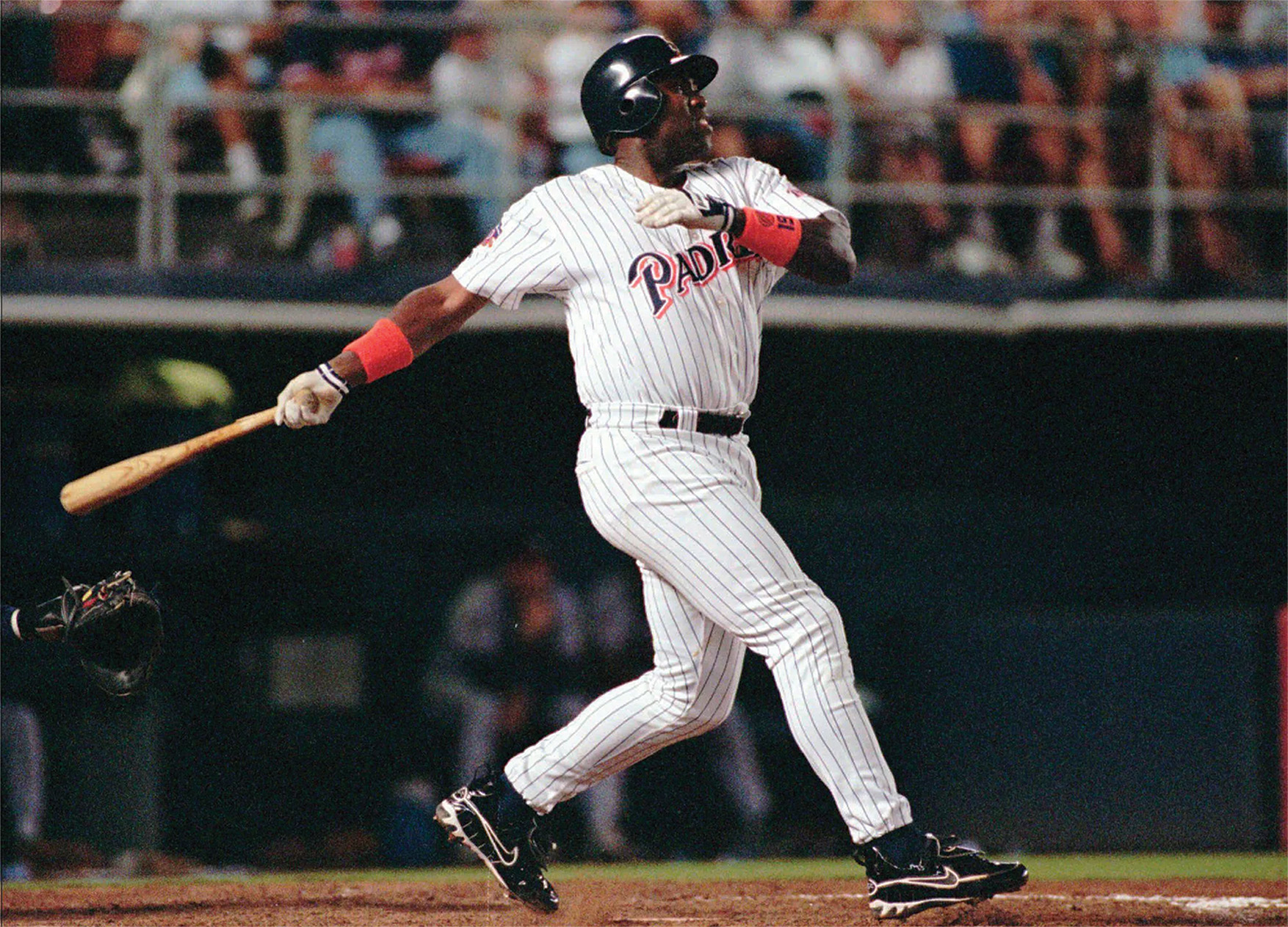
Like the great Padres hitter Tony Gwynn, Petroulias said she is a big believer in “visualization.” Gwynn would lay on a table in the dark trainer’s room just before gametime and imagine himself hitting a series of different pitches from that day’s starting pitcher. Petroulias said that was a small act of genius.
“I imagine myself doing exactly what I should be doing when I am about to perform,” she said. “It’s like practicing in your mind. I believe if you can imagine yourself doing something, you can do it.”
Conners said the most perfect frame of mind for performers and creative people is an effortless state of almost pure concentration nicknamed “the flow.” Dr. Albert Einstein has described being in “the flow,” as have Elton John, Bob Dylan, basketball legend Larry Bird and baseball superstar Willie Mays. Steven Sondheim said he wrote “perfect music” when he was in a flow state and novelist John Steinbeck said there were times he would write nearly 100 flawless pages in a single sitting.
“Flow is when you find the state where all time goes and you are just so focused on the activity at hand that you just kind of lose sight of everything else,” she said.
Petroulias said there are different ways people find their flow states.
“I always take a shower,” she said. “The water from a hot shower helps to relax your brain. Taking showers has been empirically shown to relieve muscle tension, reduce stress and increase blood flow. This helps to regulate your entire system.”
Conners said nothing builds confidence like good old-fashioned practice.
“Practice make permanent,” she said. “The way you practice is the way you will perform, so it always has to be 100 percent.”
Things can always go wrong, but entering a performance or competition focused, relaxed and well-rehearsed can minimize the appearance of the yips, Petroulias said.
“It is important that young performers and athletes feel a sense of being in control,” she said. “Feeling out of control is a terrible feeling and can cause things to unravel.”
Grace with yourself and others is always important, said Conners. Everyone, even superstars, make mistakes sometime, she said. The key is knowing how to accept them and move on.


