


Toni Gibson / The SWC Sun
By Toni Gibson
America’s silent Holocaust continues unabated.
Indigenous women go missing and are murdered at frightening rates, yet for years law enforcement has allowed the pandemic of death to proceed unchecked. Excuses abound, but meaningful efforts to address the problem are few.
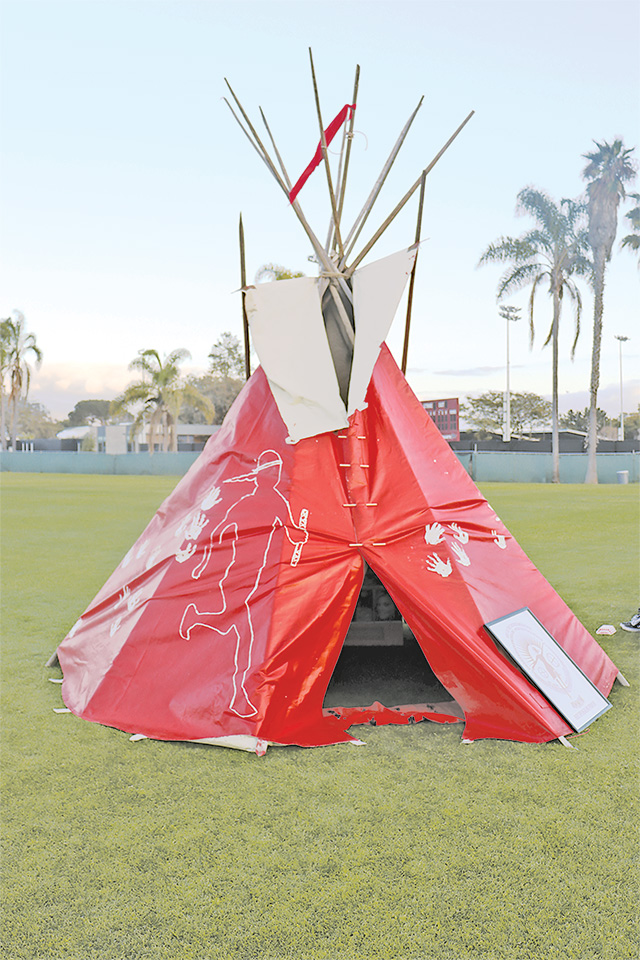
Like the iconic AIDS quilt, the Red Tipi Project has become a touring testament to an unaddressed national tragedy. Native American activists who have spoken out relentlessly about Missing and Murdered Indigenous Women and Girls (MMIW) said the United States, Canada and Mexico are slowly waking up to the systemic cruelty done to Indigenous women. The Red Tipi has become a totem of hope and resistance.
Way of the Sacred Mountain is a Native-led San Diego organization working to bring legislative and law enforcement attention to the crisis. Disinterest, poor record keeping and flaws in interjurisdictional communication by law enforcement at all levels have left Native women vulnerable to victimization, said Way of the Sacred Mountain co-founder Norm Sands.
“Over 500 years of dehumanizing has made it necessary to humanize these missing women and girls to make them human to others,” he said.
Teyana Viscarra of Way of the Sacred Mountain said accurate data about the scale of the problem does not exist, but it is almost certainly much larger than most people know.
“At least 86 percent of (Indigenous) women experience violence and 91 percent of the offenders are non-Native,” she said. “(Native People) have to be better with our 9 percent (of violent offenders), but awareness of what is happening with the other 91 percent is imperative.”
Sands said Native women and girls comprise less than 3 percent of the U.S. population but are 40 percent of the missing women in North America.
“Trafficking is the third leading cause of death in Native women ages 11-24,” he said.
Shocking examples of MMIW are plentiful. A recent high-profile case was recently solved after the tragic deaths of two Native women. High school junior Selena Not Afraid of Hardin, Montana disappeared five-and-a-half years ago. Unlike most cases, hers drew national attention. She disappeared in December when she was 16. She was found dead 20 days later from hypothermia after being abandoned at a closed rest stop without outerwear or warm clothing in the fierce Montana winter. She walked a mile and a half before she froze to death. An unidentified adult woman without shoes also perished. Her kidnapper was later convicted of negligence in their deaths rather than murder and sentenced to 10 years in prison.
Native American advocates expressed outrage at the lenient sentence. Dropping Native women in remote frigid areas without shoes or warm clothing is a favored and sadistic means of execution, advocates say.
Law enforcement has done little to protect Indigenous women, find them when they go missing or capture their killers when they die. Their cases fall between jurisdictional cracks or they disappear in remote areas, including reservations short on law enforcement. Way of the Sacred Mountain activists and others have described the situation as “the Wild West for Native women” – regions and demographics that suffer from neglect and disinterest.
In 2016 MMIW reports at the National Crime Information Center tallied 5,712 cases of missing American Indian or Alaskan Native women and girls. The U.S. Department of Justice database logged only 116 cases. DOJ and local law enforcement agencies numbers do not align with missing persons information from Tribes and reservations. MMIW activists equate this to multiple factors, including the way cases are reported. Most Native women live off Native-governed lands, which makes calculating how many women are actually reported more difficult. Only about 22 percent of Native persons live on reservations. Most consider themselves “urban Indians,” meaning there is little or no direct connection to tribal society or reservation life. Native Americans also tend to be more transient that other American demographics, which complicates reporting and data.
Appearances by the Red Tipi are part of an effort to change that, said Sands. Tipis hold special significance among many Indigenous People. It is a shelter and the center of community connectiveness. As with most tipis, the Red Tipi is set up with the entrance facing east with the back to the west to signify the rising and setting of the sun. The floor represents the earth, the walls the sky. Supporting poles, called the “bones” by many Nations, represent the trails from the Earth to the Spirit World. They reach toward the sky as a connection to the Creator.
The Red Tipi has further symbolic meaning. Many Native People believe that red can be seen by spirits, which helps them find their way back to their families.
White handprints on the outside are made by family members and friends of someone missing or murdered. White represents hope and prayer.
Red Tipis are steadily spreading across the United States and Canada. They are often displayed in front of police stations and government buildings to express unhappiness over the lack of support given to Indigenous women and the need to continue trying to solve cases. They are gifted to communities working toward justice.
“They have to be serious about doing the work,” said Sand. “When a community is ready, there is a gifting ceremony for the new tipi.”
Way of the Sacred Mountain activists have a dream to someday see 50 Red Tipis on the National Mall in Washington D.C. to bring attention to the plight of Indigenous women and girls.
Persons with information on a missing or murdered Native person are encouraged to contact The Way of the Sacred Mountain at wayofthesacredmountain@gmail.com, the Murdered and Missing Indigenous Women at hope@nativehope.org, or their local law enforcement agency.


