


Josh Whitehead / The SWC Sun
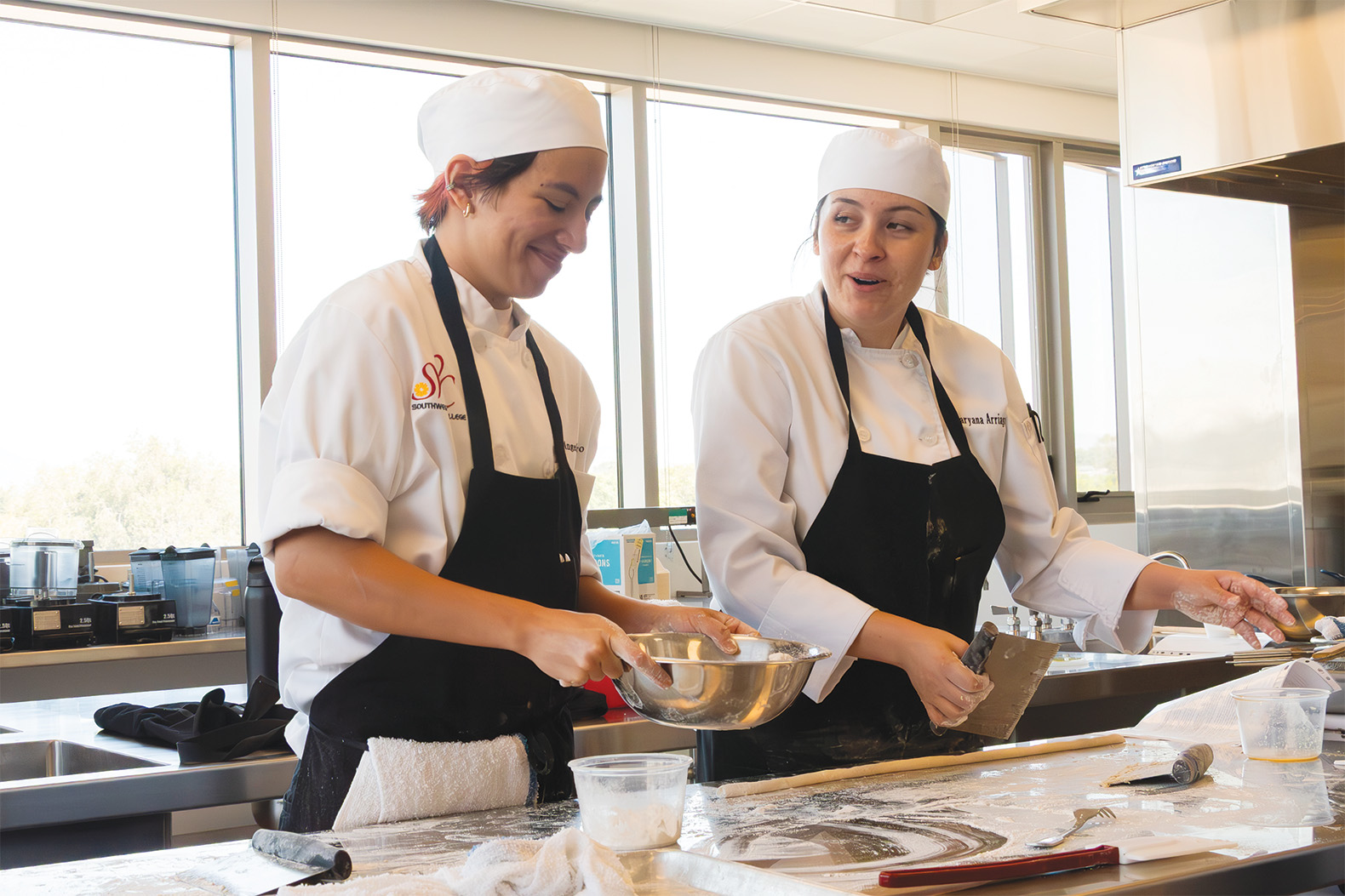
FLOUR POWER—Culinary arts students whip up a recipe in the new second story kitchen in the Student Union Building.
By Madelyn Batuyong
Culinary lords and ladies of the night have left the darkness and come into the light. More important, they have come into new digs.
Southwestern College has had a well-regarded culinary arts program for decades but never had a proper educational kitchen.
Until now.
When college leaders cut the ribbon for the new Student Union Building they also cut away one of the biggest barriers of the straightjacketed culinary arts program. The spacious, state-of-the-art facility on the second floor is designed to mirror professional kitchens. Chef Kris Saradpon said it was a game changer.
“Having a culinary arts program here in the South Bay is huge,” he said. “(Southwestern College) trains so much of the workforce in the county. Now that we have a school to teach those who aspire to be chefs, they don’t have to spend thousands of dollars to travel to another culinary school. They get to stay local and really help build our community and talent.”
Saradpon said the program and its curriculum were always solid, but the facilities were challenging.
“We were housed in a snack bar at the Devore Stadium,” he said. “It was a small space but we had everything we needed. It was meant to function as a snack bar, so when it was hot, it was really hot.”
Culinary students had to be night owls, he said.
“For about 20 years our program had to wait until 4 p.m. until the cafeteria closed so we could offer class,” he recalled. “So for a long time our students stayed after dark. It makes you think about the safety and equity and those who have young kids.”
Students now use commercial-grade equipment, including high-powered burners, professional fryers, high-temp ovens and spacious grills — all in a safer environment with clear sightlines for instructor supervision.
“This is what a real kitchen looks like and now our students experience the difference firsthand,” he said. “There’s not large pieces of equipment with blind spots.”
Saradpon, an assistant professor of culinary arts, said he uses a hybrid teaching model with online readings and labs in the kitchen.
“Students break into teams handling different ingredients, learning techniques across a range of foods and building palate memory for professional work environments,” he said.
Students are encouraged to treat mistakes as learning opportunities.
“Even if you burn something and mess it up, there’s still a lot of lessons to be learned in that mistake,” he said.
He wants the program to instill professional habits, he said.
“Time is everything in the kitchen,” he said. “Tardiness has real consequences, just like in the workplace. Every class ends with a group cleanup.”
Students should work part-time in the industry, Saradpon said.
“Working and studying go together. Applying classroom knowledge on the job gives students real context and work experience enriches the classroom. The best advice I got was simple – read everything, try new foods and don’t judge before tasting.”
The best is yet to come, Saradpon said.
“We aim to grow strategically, making sure we’re good stewards of the investment taxpayers have made,” he said.
Culinary arts students may be tucked away in their spacious new corner of the Student Center, but their presence is known as the aroma of fresh bread and simmering meals wafts through the halls. Some of the fresh hot food will be sold in the downstairs cafeteria, expanding offerings beyond the burgers, fries and quesadillas of the past 50 years.
Saradpon said he was glad there were more cooks in the kitchen and predicted a hot new age for culinary artists. All the ingredients are there.


