


Carla Labto / The SWC Sun
By Julio Rodriguez
A Perspective
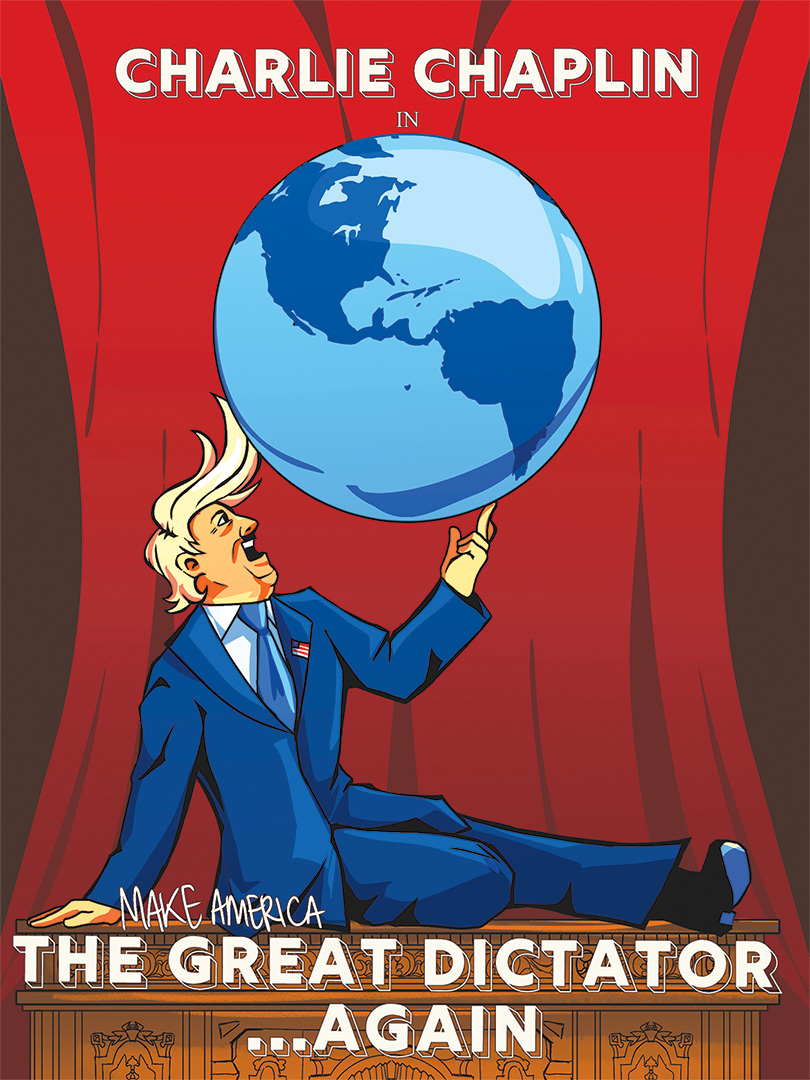
Silent film king Charlie Chaplin’s first movie with dialogue was a doozie. It was also prophetic.
“The way of life can be free and beautiful, but we have lost our way. Greed has poisoned men’s souls, has barricaded the country with hate and has goose-stepped us into misery.”
Chaplin’s iconic final speech from his classic 1940 film “The Great Dictator” resonates today in the Age of Trump as it did in the Age of Hitler. When the film was released 85 years ago Chaplin presciently showed audiences life under dictatorship. Americans had not yet tasted World War II and Chaplin worried his adopted country was about to be blindsided. He was so right.
As he often did, Chaplin played multiple roles in “The Great Dictator,” in this case the primary hero and villain, the oppressor and the oppressed. Fascist autocrat Adenoid Hynkel is the ruthless dictator of Tomania and an almost-carbon copy of Adolph Hitler. The Jewish Barber, a World War I hero suffering from amnesia, represents the Jews of Europe tormented and murdered by Hitler. More importantly, in today’s context, he represents the tyrant’s “enemy from within,” much like Latinos and people of color are Trump’s “enemies from within” the United States.
Chaplin channeled Hitler and foresaw Trump. At times it almost seems like Trump is reading from Hynkel’s script. Silliness whitewashes seriousness, overload negates critical thinking, bread and circuses distract from real problems.
Hynkel is introduced to the audience making a loud, nonsensical and flatulent speech to his captive nation. It was Trump’s golden escalator speech without the golden escalator, full of “othering,” name calling and racial scapegoating. Hynkel’s antisemitism and Trump’s racism are dealt from the bottom of the same demonic deck. “Radical Left,” “rapists,” “criminals” and “freeloaders” rang forth from Trump Tower as sensible people rolled their eyes at the shrill silliness of it.
But it worked. These attacks rallied legions of grievant supplicants against a common “enemy” they did not know they had a week earlier.
Chaplin’s paramilitary force was called “Stormtroopers” – not a coincidence “Star Wars” fans. Hitler called his goons the “Gestapo.” Trump’s is called ICE. They intimidate opponents and “keep people in line” by means of harassment, property destruction and summary executions. Fear was weaponized and conducted by the authoritarians like Satan’s Symphony, further empowering the authoritarian.
It is not a coincidence that Trump and ICE echo Hitler and his Gestapo. ICE rounds up migrants (or people who have dark skin like migrants) and casts them as the menacing “bad hombres” and “cantaloupe girls.” People who ally themselves with the mistreated – including immigration lawyers, journalists, college professors – are also denigrated. (Immigration attorneys – even fifth and sixth generation Americans – have been ordered by the Department of Homeland Security to leave the country.)
Dictators crave the ability to silence dissenters. Hynkel used his military, just as Hitler did. When Hynkel’s conscientious Commander Shultz refused to attack the Jewish ghetto, the dictator sends him to a concentration camp for “treason.” Trump is arresting (or suing) Americans who criticize him, including James Comey, John Bolton, Leticia James, Frani Willis and so many more. At least Shultz was not sent to gulags in El Salvador, Somalia, Colombia, Brazil or Alligator Alcatraz.
Too many Americans have lost their way and forgotten the most sacred values of our humanity. At the climax of the film the Barber is mistaken for Hynkel and delivers a stunning speech denouncing authoritarianism and violence. It is one of Hollywood’s most memorable performances and a pique of Chaplin’s idealistic brilliance.
Parallels with Trump are chilling. As our country devolves further into authoritarianism Chaplin’s words echo like thunder across our purple mountains majesty. “More than machinery we need humanity. More than cleverness we need kindness and gentleness. Without these qualities life will be violent and all will be lost.”
Americans who love our nation and its great experiment with multiracial democracy must fight back with empathy and kindness. Otherwise the freedoms we take for granted will be swept away forever.
Chaplin urged us not to give in to a regime that wants to destroy peace and freedom for greed and power. We have seen men like Donald Trump before who seek power to “free themselves and enslave others.” They pop up like spiny weeds in gardens of democracy and must be pulled.
About the same time Chaplin was inveighing against Hitler, the Indian liberation leader Mohandas Gandhi was speaking out against tyranny and oppression. Chaplin would have loved the 1982 film about “the Great Soul” which ended with this powerful speech:
“When I despair, I remember that all through history the way of truth and love have always won. There have been tyrants and murders, and for a while they can seem invincible, but in the end they always fail. Think of it – always.”


