


Dira Marie Wong / The SWC Sun Photos
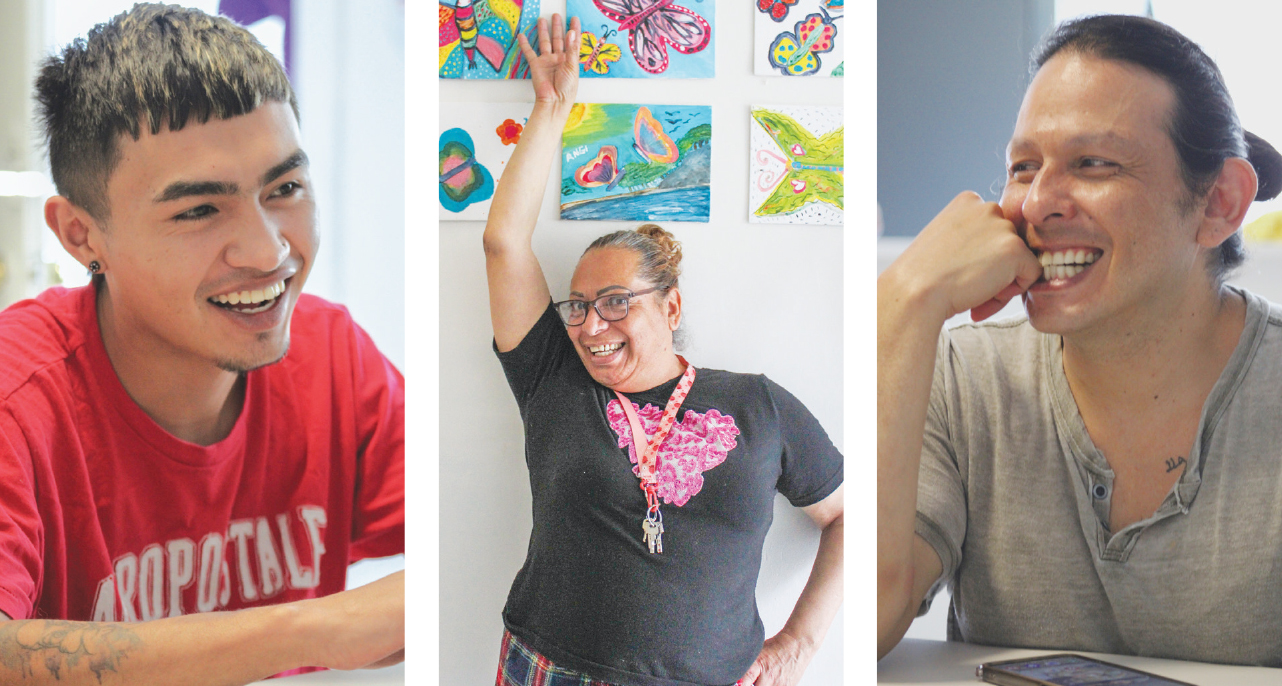
MARIPOSA MARAVILLOSA—Jardin de las Mariposas residents fled their hometowns in central and southern Mexico due to cartel violence and anti-LGBTQ discrimination.
By Alfonso Julián Camacho
TIJUANA—She ran in terror. She ran for her life. She “ran like a man.”
Like a real life horror film she fell and scrambled to her feet as the killers gained on her. It was a desperate dash toward the adjacent ranch. It was guarded by a different drug cartel. She would be safe there – for a while.
Transgender people are the most abused and most murdered of all Americans. They are even less safe in homophobic Mexico. A hyper-machismo culture that gave rise to sadistically-violent drug cartels has no grace for non-binary Mexicanos. Rural LGBTQ citizens are particularly vulnerable to mistreatment, violence and death. Fortunate survivors find their way to the Jardin de las Mariposas in Tijuana, a safe house and treatment center for LGBTQ Mexicans and Latin Americans.
Samantha García Rodriguez, 55, a transgender woman, said her quiet life working the fields in Michoacan was obliterated by cartel violence. She and her five dogs lived on land “protected” by drug lords that often used the remote rural outposts for cultivation of crops used for narcotics production or as distant hideaways for labs and “cooking” operations where organic materials begin the process of synthesizing into cocaine, methamphetamine or fentanyl.
For a while Rodriguez remained in the cartel’s favor. Twice she received Christmas baskets brimming with pantry items. She accepted them, not realizing they came with a steep cost. “Gifts” from cartel soldiers often come with future expectations.
It was a day like any other, she said, when gunmen knocked on her door and asked her to “cook” for the cartel. She declined. She received two more visits and stood her ground.
A fourth visit unleashed the wrath of the spurned narcos. They shot her dogs, then hogtied her hands and feet. Rodriguez thought she was doomed to die.
“They arrived at 2:45 p.m. and told me that I was dead,” she said.
They called her a Spanish homophobic epithet, she said, and told her they were calling their “godfather” to determine in which gruesome manner she would die. Miraculously, though, the cartel don did not answer his phone.
“Then they told me, ‘This is your last night,’” she said. “They threatened unmentionable sex acts and urinated on me in my own house. They kept me tied up for three days. On the third day they left me to go collect their quotas. God helped me and I was able to free myself. I arrived at (LGBTQ safehouse) Jardin de las Mariposas all beaten up.”
Rodriguez said she “ran like a man” through towering fields of corn to hide from cartel watchmen, corrupt cops and narcotraficante snipers.
TIJUANA’S SECRET SANCTUARY
Jardín de las Mariposas is the secret garden for Rodriguez and other members of the LGBTQ community like Elmer Madrid, 26, of Santa Cruz de Yojoa Cortés, Honduras. He has lived there for four months after fleeing abuse by homophobic family members, he said. He fled to Tegucigalpa, obtained Mexican residency in Tapachula, moved to Guadalajara and is now in Tijuana. Jardin de las Mariposas is his sanctuary, he said.
“I really enjoy being here,” he said. “We can share the space and participate in workshops. We do not have to be alone. We can talk, we argue, we laugh, we understand each other. We feel safe.”
Cecilia González Farias, 32, a transgender woman, agreed. A native of Michoacan, she lived on a ranch where she was harassed for being “marimacha,” a derogatory Spanish word for LGBTQ women.
“I escaped from the cartels of Michoacan,” she said. “There are no honest police, they collude with the cartels. Because I was part of the (LGBTQ) community, they would say things to me like ‘we are going to kill those (expletives).’”
Gonzalez Farias said she heard about Jardin de las Mariposas from another bisexual person.
“I came here before (the cartels) did something to me because I saw them kill people,” she said. “I applied (for asylum) for eight months to cross the border until Trump cancelled the CBP app.”
González said she can never return home and dreams of refuge in the United States.
Yovany Andrés, 19, of Bogota, Colombia is a recent arrival to Jardin de las Mariposas. He said he fled economic hardship and homophobia. He was detained by Mexican immigration officials several times, he said.
“There were bad people who said ‘we will send you back to Colombia, we are going to deport you,’” he said. “I have fought through too much to get sent back to Colombia.”
CHASED FROM
THREE COUNTRIES
Jesenia Santos, 38, from Apple Valley, California, said she was brutally ripped away from everything she knew when she was deported from the United States. She had lived in California since she was a young child and her native language is English. She was deported for stealing a Snickers candy bar.
“I did not get to say goodbye to my family when I was deported,” she said. “They are also undocumented, so visiting me put them at risk. I was deported among children who were by themselves. It was horrific.”
Santos said she was fortunate to have an aunt who lives in Ensenada. Although the aunt said she disapproved of Santos’ lifestyle as a transgender woman, she opened her home. Santos, however, yearned to return to Apple Valley. She paid $2,000 to a smuggler to get her across the border and through the scorching Rumorosa region surrounding Mexicali. Santos ran out of food and water in the triple-digit wasteland. When she reached the border, there were bottles of water left by human rights activists in the desert.
Their thoughtfulness made her cry, she said.
She fell asleep and awakened to find the coyotes had abandoned her in the desert. Facing certain death, she hiked back across the border into Mexico where a stranger gave her food, shelter and another chance to live. She eventually reached Canada where she found a home, a partner and healthcare.
Santos, who is HIV positive, still considers Canada home, she said, but policy changes caused her to lose her benefits. She returned to Mexico to receive HIV medication, but there is a cost. HIV patients are targets of homophobia and abuse – as are health care providers and researchers.
DOCTORS FACE DANGER
Daniel Valdez Márquez, Ph.D., 38, is a cultural studies researcher doing a Doctoral Fellowship at the Colegio de la Frontera Norte. His research focuses on migrants with HIV and AIDS.
It is not a popular area of study.
Corruption and corrosive attitudes in Mexico toward the LGBTQ community forced him to conduct his research at community clinics rather than government hospitals.
“Migrants come from South American countries like Honduras and El Salvador where medical confidentiality does not exist,” he said. “Patients fear seeking treatment because doctors may share the diagnosis, which can make them outcasts unable to find employment. So they flee their countries to seek treatment. Mexican doctors see (Central and South Americans) as a burden. They may not treat them because they assume they will soon go to the U.S. for treatment. Migrants are afraid to share their story for fear of discrimination.”
Valdez said the lack of proper treatment can have heartbreaking consequences. A woman infected with HIV by her husband gave birth to an HIV-positive baby. Without pediatric treatment the infant developed full blown AIDS.
Valdez said he hopes his efforts to document discrimination will lead to new government policies and societal change. For now, he said, migrant centers like Jardin de las Mariposa are doing the heavy lifting.
Tijuana’s AIDS Healthcare Foundation (AHF) is also attacking the problem. Its staff and volunteers host weekend “testing parties” on Tijuana streets to identify HIV positive people and steer them toward treatment.
Most HIV positive people express appreciation for the unexpected help, but some abuse the free medicines by selling it on eBay. Valdez said it is often purchased by people who will not visit an HIV clinic out of shame.
Many health clinics refuse to offer HIV treatments, Valdez said.
“Stigma and discrimination are a problem,” he said. “Beyond the medical issues, we need a new more culturally sensitive vision.”
TIJUANA CLINICS
PUSH BACK
Sergio Lagarde, 45, Marketing Director for Latin America and the Caribbean for AHF, agreed.
“The problem is more than the HIV, it’s the stigma,” he said. “HIV is taboo and there is a prohibition about discussing the human body and sexuality.”
Even so, LaGarde said, regional health care providers are making robust efforts.
“In the Tijuana area we have prevention programs, testing and networks to help people find treatment. We operate a testing center 200 meters away from the border. We support men having sex with men, sex workers and trans people by giving them free HIV tests.”
Lagarde said migrants’ with HIV need condoms.
“It takes a month and a half to travel from Venezuela to Mexico,” he said. “Without protection it leaves a trail of disease. Condoms cost more than the daily price of food. For poor migrants, the decision comes down to survival. Providing free protection is the way. Last year we delivered almost 10 million condoms – 800,000 in Tijuana.”
An HIV positive person can live a very long life with proper care, said LaGarde. Too many Latin American nations make it difficult to provide information, tests and treatment due to outdated attitudes and cultural biases, he said.
People like Samantha García Rodriguez said they have found hope and a degree of peace at Jardin de las Mariposas. For acceptance and equal treatment, however, they still have a long, long way to run.
Dira Marie Wong contributed
to this story.


