


With the stroke of a sharpie, House Resolution 1 or the “Big Beautiful Bill” slashed federal funding to California’s public health insurance program Medi-Cal to the tune of $30 billion a year. Potentially plunging 3.4 million state residents into the tribulations of losing coverage amid already strenuous economic tensions brought on by the Trump administration’s domestic and global policy decisions.
In response, a signature gathering citizen initiative was led by The Service Employees International Union-United Healthcare Workers West to place Proposition 40 on the upcoming Nov. 3 ballot. Prop 40 would levy a one time 5% wealth tax on Californians with more than $1 billion in assets excluding pensions and real estate to fund healthcare and education. Backers of the proposition include Sen. Bernie Sanders, U.S Rep. Ro Khana, the Democratic Party of California, and the California Democratic Socialists of America among others. The nonpartisan Legislative Analysts Office estimates that Prop 40 would produce an uptick of tens of billions dollars in near term revenue.
Prop 40’s revenue would be placed in a reserve fund where 90% of the money would fund medi-cal and other health coverage for low to moderate income individuals. The remaining 10% would fund public education K-14 and food assistance programs such as CalFresh, CALFAP, as well as California Universal Meals Program for school meals.
Prop 40 has found itself in direct competition with two other ballot measures, Prop 41 and Prop 42 written specifically to nullify 40. Both are backed and designed by Building a Better California, the main opponent of the wealth tax.
If either of the competing propositions were to pass alongside Proposition 40 it would spell certain death for the proposed wealth tax.
Campaign Spending
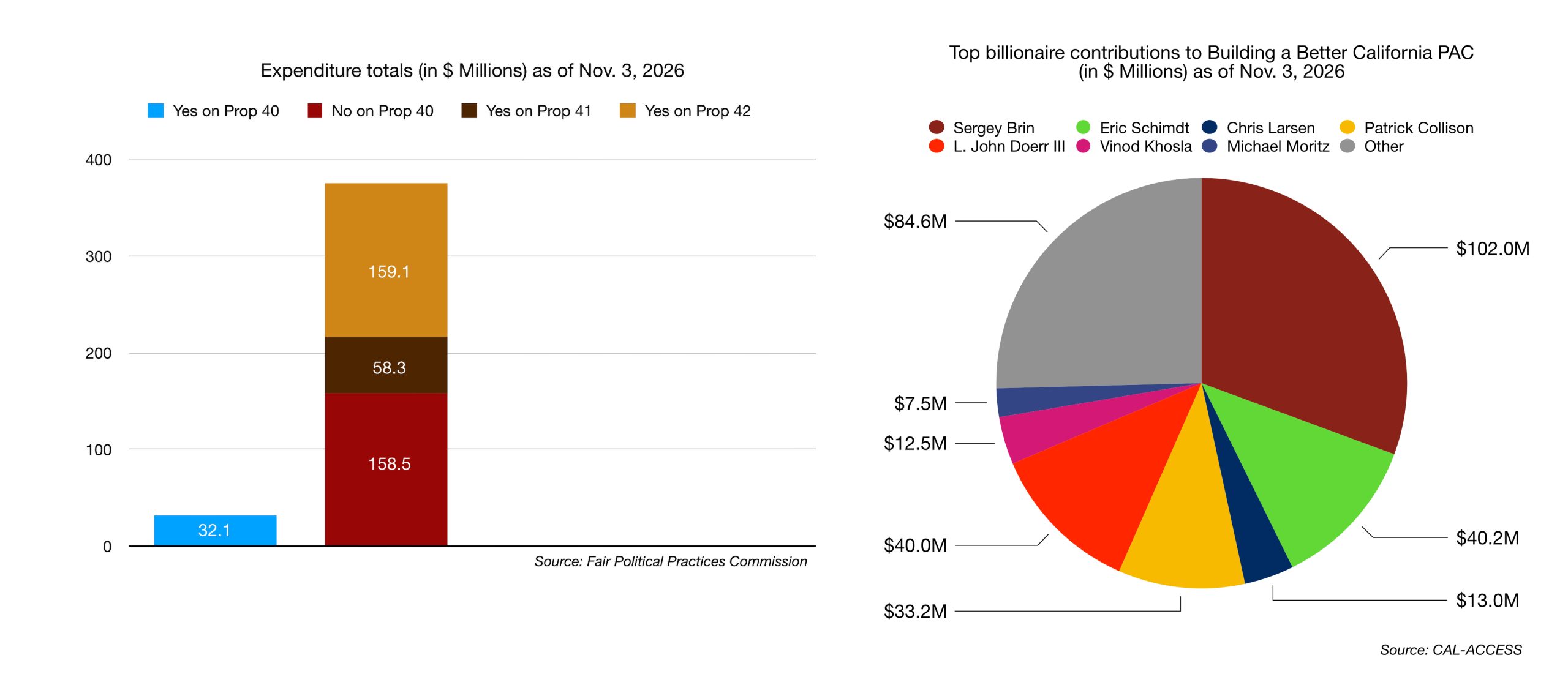
These competing ballot measures are the trump cards of a multi-million dollar campaign funded almost entirely by Building a Better California, a political action committee (PAC). The PAC was co-founded by Google cofounder Sergey Brin and former Google CEO Eric Schmidt in February 2026 with the sole purpose of opposing the wealth tax. Brin himself has poured $102 million into this PAC through seven separate transactions, while Schmidt has contributed over five times totalling over $40 million.
As of Oct. 8 at least $282.1 million in contributions to Building a Better California have been identified and a total of $248 million dollars has been spent against Prop 40.
$88 million allocated to the “No on 40” campaign and an additional $160 million split between pro-Prop 41 and 42 efforts.
Beyond the Ads
A substantial amount of this money has been used to run a blitz of anti-Prop 40 television and mail advertisements. Most notably the Yes on 42 ads that claim the proposition will become an “everyone tax” due to a hidden loophole in the proposition. The No on 40 ads also claim the inevitability of billionaire flight will cost California billions.
These claims have become a major concern for many everyday Californians who worry about their economic security and their safety nets. Proponents of Prop 40 assert that the ad fails to inform voters that any amendments have to stay consistent with the initial intent and language of the proposition which is to tax billionaires, not everyday Americans with retirement or savings accounts.
Concerning the economic blow to California as a whole, UC Berkeley economist Gabriel Zucman and Emmanuel Saez, coauthor of the initiative, argue that even if every billionaire left California, it would take 25 years for the lost state income tax to reach the projected injection of funding by the wealth tax.
Sen. Bernie Sanders also took to Twitter, now known as X, to call the billionaires’ threat of exodus a “bluff” explaining that,” Since Prop 40 was filed, California gained 32 billionaires & billionaires in California got $381 billion richer”.
Professor Charles C. Clark, an adjunct political science professor at Southwestern Community College and Cal State San Marcos was adamant that voters need to do their homework and get better informed from trustworthy sources such as CalMatters.
“The commercials and flyers, it’s candy. It’s designed to feed you a little bit, make you feel good or bad about something, but it’s not going to sustain you,” he said. “Something like CalMatters, that’s your actual food. You’ll be able to feed from it, feed the mind in order to make a determination of which way you would like to vote.”
Clark challenged the tax himself, questioning whether Prop 40 was a long lasting solution and would have more support if it was working in conjunction with the state legislature to make sure that there were stronger protections or funding triggers alongside a robust and organized rainy-day fund. He also argued that reform of California’s traditional funding methods toward certain public sectors was necessary to prevent any budget deficits or industry short falls in the future.
“What needs to be analyzed is the spending that the state does on its various programs,” Clark said. “How are they spending the money? Is there a better way to have this spent? Do we need to look at system adjustments as far as how medical is appropriated? A bandaid fix is only going to get you so far.”
According to an economic study by the National Bureau of Economic Research (NBER), the wealth of the top 0.001% of California households, reached $2.3 trillion dollars by mid- 2026 – or more than the combined wealth of every single California taxpayer while only contributing 2.4% of the state total income tax revenue.
- A yes vote on prop 40 would approve the wealth tax and enact the one time 5% tax on eligible Californians with more than $1 billion dollars in assets.
- A yes vote on prop 41 would nullify the proposition from passing by holding it accountable to the states spending limit rules.
- A yes vote on 42 would prevent any future wealth taxes on billionaire’s assets.
The choice is ultimately in the hands of Californians this November. A choice between passing a one-time wealth tax now or never being able to pass any form of wealth tax for the foreseeable future.


